AI Agents Are Coming to Small Business — But Don't Give Them the Keys Yet

Opinion: Agentic AI could become the biggest productivity leap since cloud software. But SMEs shouldn't confuse intelligence with trustworthiness. Give AI agents responsibility before authority, and let them earn the keys through oversight, audit trails and proven performance.
The next member of your team probably won't be human.
Over the next few years, many small businesses won't just use AI to answer questions or write emails. They'll employ AI agents that can take action.
An AI agent might answer customer enquiries overnight, update your CRM, schedule appointments, chase invoices, prepare quotations, monitor stock levels or coordinate projects across multiple business systems. Instead of waiting for instructions one prompt at a time, it can plan, decide and complete tasks with minimal human intervention.
That's exciting.
It's also where many businesses are about to make their biggest mistake.
The temptation will be to give these digital workers unrestricted access to business systems because they appear capable. But capability isn't the same as trust. You wouldn't hand a new employee the company credit card, payroll system and customer database on their first morning. AI agents deserve the same measured approach.
The businesses that benefit most from agentic AI won't be those that automate everything overnight. They'll be the ones that introduce autonomy gradually, with clear permissions, human oversight and accountability.
What Makes AI Agents Different?
Most people have experienced AI through tools like ChatGPT, Copilot or Gemini. You ask a question, receive an answer and decide what to do next.
AI agents change that relationship.
Instead of simply responding to prompts, they can:
- plan a sequence of tasks
- access software through APIs
- update business systems
- communicate with customers
- trigger workflows
- monitor events
- make limited operational decisions without waiting for another instruction.
In other words, they don't just generate information—they can perform work.
For SMEs struggling with staff shortages, repetitive administration and rising costs, that's a significant opportunity.
Why Small Businesses Should Be Excited
Much of the conversation around agentic AI focuses on futuristic scenarios. The reality is more practical.
Imagine arriving at work to find that overnight your AI agent has:
- categorised new enquiries
- requested missing information from prospective customers
- booked appointments into available diary slots
- updated your CRM
- summarised important emails
- highlighted only the conversations that genuinely need your attention.
None of those tasks replace your expertise. They remove repetitive administration so you can spend more time serving customers and growing your business.
Done well, agentic AI doesn't replace people. It helps people spend less time acting like software.
The Mistake Businesses Are About to Make
The danger isn't that AI agents exist.
The danger is assuming that because an AI agent can do something, it should.
There's a difference between automation and delegation.
Traditional automation follows predefined rules. If A happens, do B.
Agentic AI operates with objectives rather than rigid instructions. It can evaluate situations, choose between actions and adapt its approach.
That flexibility is what makes it powerful—but it's also why governance matters.
Giving an AI agent unrestricted authority over financial systems, customer records or HR processes isn't innovation. It's poor management.
The ICO Is Asking the Right Questions
The Information Commissioner's Office (ICO) is actively examining the implications of agentic AI and automated decision-making. Rather than discouraging adoption, its focus is on ensuring organisations remain accountable for decisions made with increasingly autonomous systems.
For businesses, the message is straightforward.
If an AI agent handles personal data or influences decisions that affect customers or employees, responsibility doesn't transfer to the software. It remains with the organisation using it.
That means SMEs need to think beyond productivity and consider:
- who approved the AI's actions
- what information it accessed
- whether decisions can be explained
- whether people retain meaningful oversight
- how actions are recorded and audited.
These aren't barriers to innovation—they're the foundations of responsible AI adoption.
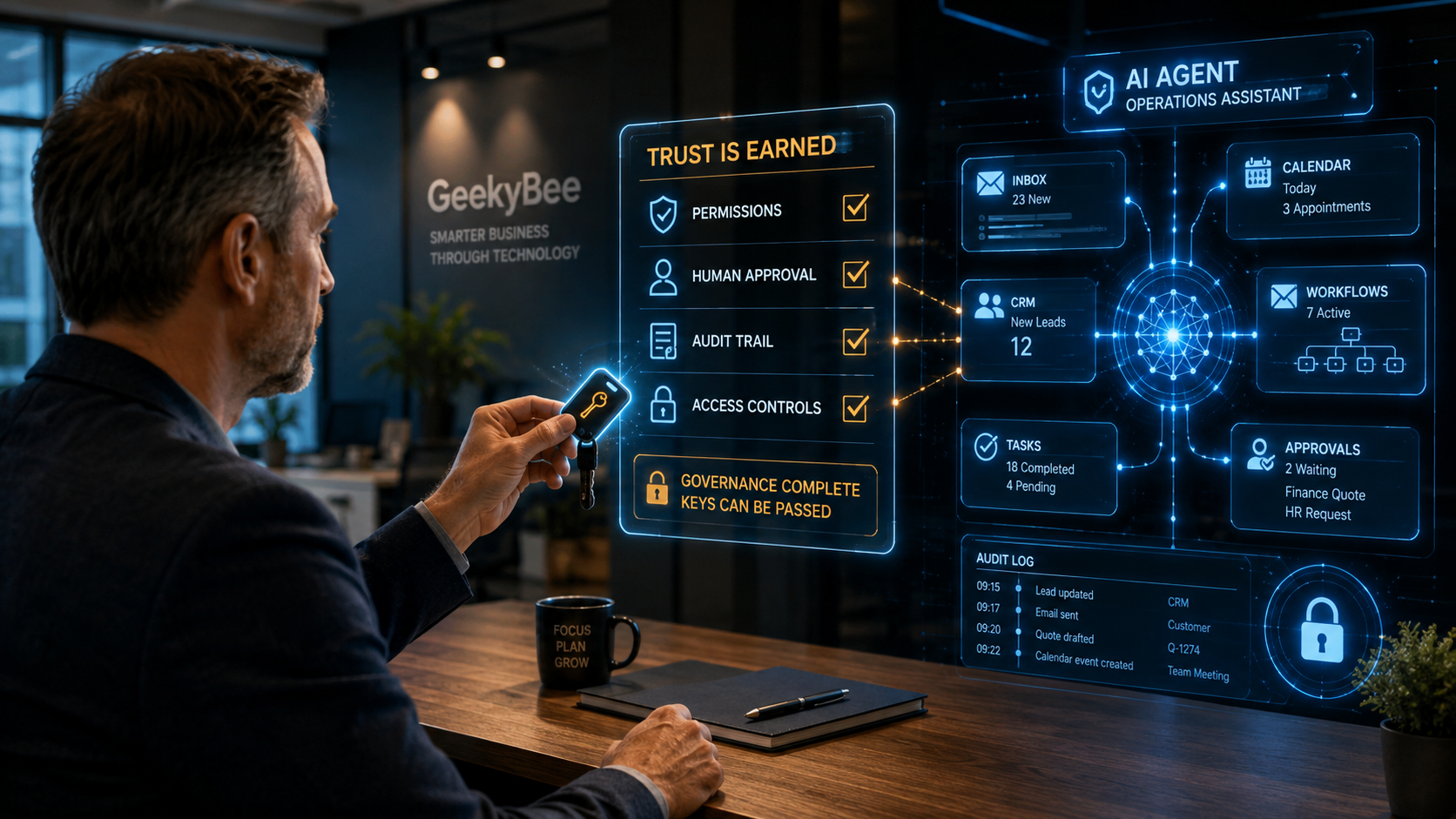
AI Agents Should Earn the Keys
This is where I think many businesses are approaching AI the wrong way.
The question isn't:
"Can this AI do the job?"
The better question is:
"Has this AI earned enough trust to do the job without supervision?"
Trust should be built in stages.
Level 1: Observe
The AI analyses workflows and makes no changes. It learns how work is currently done.
Level 2: Recommend
The AI suggests actions but humans make every decision. This is the safest place to begin.
Level 3: Draft
The AI prepares emails, quotations, reports and updates for approval. Humans review before anything is sent or changed.
Level 4: Execute
The AI performs clearly defined, low-risk tasks automatically. Every action is logged.
Level 5: Delegate
Only after demonstrating consistent accuracy should an AI agent make limited operational decisions independently—and even then, within carefully defined boundaries. The important point is that autonomy isn't binary. It's earned.
Four Controls Every SME Should Put in Place
Introducing AI agents responsibly doesn't require enterprise budgets. It requires sensible governance.
1. Least-Privilege Access
An AI agent should only have access to the systems and information it genuinely needs. If it books appointments, it probably doesn't need access to payroll. If it drafts quotations, it probably doesn't need administrator rights across your entire CRM. Limiting permissions reduces both mistakes and security risks.
2. Human Approval for High-Risk Actions
Some decisions should never happen without a person reviewing them.
Examples include:
- approving refunds
- authorising payments
- deleting customer records
- issuing contracts
- making HR decisions.
AI can prepare these actions, but people should approve them.
3. Audit Trails
Every significant AI action should be traceable. If customer information changes, you should know:
- what changed
- when it changed
- why it changed
- which AI agent performed the action.
If you can't explain what your AI has done, you can't manage it effectively.
4. A Kill Switch
Every autonomous system should be easy to pause or disable. If something behaves unexpectedly, you should be able to stop it immediately without disrupting the rest of your business. Resilience isn't just about preventing problems. It's about recovering quickly when they happen.
Where Should SMEs Start?
The best first use cases are repetitive, low-risk and easy to verify.
Good starting points include:
- summarising emails
- updating CRM records
- scheduling appointments
- categorising enquiries
- preparing quotations
- generating meeting notes.
Poor first choices include:
- approving invoices
- processing payroll
- responding to GDPR requests
- deleting records
- making employment decisions
- transferring money.
Start where mistakes are reversible.
Expand only when confidence grows.
The GeekyBee Recommendation
Don't start by asking how autonomous your AI agent can become. Start by deciding how much responsibility it has earned.
Introduce AI agents gradually.
Let them observe first. Then recommend. Then draft. Then automate carefully defined tasks. Only consider greater autonomy once you've established clear permissions, meaningful human oversight and comprehensive audit trails.
The businesses that benefit most from agentic AI won't be the ones that hand over the keys on day one. They'll be the ones that build trust step by step. Because responsible AI adoption isn't about slowing innovation. It's about making sure innovation remains under your control.
Frequently Asked Questions
What is an AI agent?
An AI agent is software that can plan and complete tasks on your behalf rather than simply responding to prompts. It can interact with business systems, use tools, make decisions within defined limits and complete workflows.
Can small businesses benefit from AI agents?
Yes. Many SMEs can save significant time by using AI agents for repetitive administrative work such as scheduling, customer enquiries, document preparation and CRM updates. The key is introducing autonomy gradually.
Should AI agents make business decisions on their own?
Not initially. High-impact decisions involving finances, legal obligations, employees or customers should continue to involve meaningful human oversight.
What's the biggest risk with agentic AI?
The greatest risk isn't the technology itself—it's granting excessive authority without appropriate governance, permissions and monitoring.
How should an SME get started?
Begin with low-risk tasks that save time but are easy to review. Establish clear approval processes, maintain audit trails and expand autonomy only after the system has demonstrated consistent, reliable performance.
Final Thought
Agentic AI isn't another technology trend that businesses can afford to ignore. It has the potential to transform how SMEs operate over the next decade.
But the smartest businesses won't ask, "How much can AI do?"
They'll ask, "How much should we let it do today?"
That's the difference between adopting AI and managing it responsibly.