APIs vs MCP: What's the Difference, Do You Need Both, and Every Other Question You Were Too Afraid to Ask
API or MCP — wrong question. One's the kitchen, the other's the menu and waiter. APIs let software talk to software; MCP lets AI discover what it can actually do with it. Neither replaces the other, and increasingly, good platforms will need both.

A plain-English guide to the acronym everyone in AI is suddenly using
If you work anywhere near AI at the moment, you've probably started hearing three letters rather a lot:
MCP.
And if you've worked with technology for any length of time, you probably already know another three:
API.
Which naturally raises a few questions. Is MCP replacing APIs? Is it just a better type of API? Do you need to rebuild everything? Why does your AI suddenly need an MCP server?
And, perhaps most importantly:
What on earth is the difference?
The good news is the answer is much simpler than some of the technical explanations make it sound. APIs and MCP solve related problems, but at different levels — and increasingly, we're going to need both.
What Is an API?
API stands for Application Programming Interface. It's a defined way for one piece of software to communicate with another.
Imagine we build an appointment booking system. Our application might need to find available appointments, create a patient, book an appointment, move it, or cancel it. The practice management platform provides an API containing functions that let us do exactly that.
Our software sends a request — "show me available appointments next Tuesday" — and the API returns structured data. Our application then decides what to do with it.
APIs are everywhere. Stripe uses them for payments. Google uses them for maps, calendars and email. Accounting systems, CRMs, logistics platforms, property systems, social networks and practically every modern SaaS platform expose an API in one form or another. They're one of the fundamental building blocks of modern software, and they're not going anywhere.
What Is MCP (Model Context Protocol)?
MCP stands for Model Context Protocol. It was originally introduced by Anthropic as an open protocol designed to give AI systems a standard way to connect to external tools and data.
That last part is the important bit: AI systems.
Traditional APIs were primarily designed for software developers writing software integrations. MCP is designed around AI models discovering and using capabilities. It's a subtle distinction, but an extremely important one.
Consider our appointment system again. An API might expose endpoints like GET /appointments, POST /patients, or DELETE /appointments/{id}. A developer reads the documentation, understands those endpoints, and writes software that knows exactly when and how to call each one.
An AI model has a different problem. It needs to work out:
- What can I do?
- Which tool should I use?
- What information does that tool need from me?
- What will it return?
- When should I actually use it?
MCP provides a standardised way of presenting those capabilities to an AI. That's the key difference.
The Restaurant Analogy
Here's perhaps the easiest way to picture it.
Imagine walking into a restaurant. The API is the kitchen — it has the equipment, ingredients, processes and people capable of producing things. But you need to know how the kitchen works to get anything out of it.
MCP is closer to the menu and the waiter. It tells you what's available, what each dish does, what information it needs from you, and it translates your request into something the kitchen understands.
The menu doesn't replace the kitchen. Without the kitchen, there's nothing to serve. And the kitchen doesn't become obsolete just because somebody wrote a better menu.
They solve different parts of the same problem.
Does MCP Replace APIs?
No. This is probably the biggest misconception surrounding MCP.
In most implementations, the MCP server actually uses APIs underneath. The architecture typically looks something like:
AI Assistant → MCP Server → API → Business System → Database
For example: AI Agent → MCP → Cliniko API → Appointment System. Or: AI Assistant → MCP → Stripe API → Payment Platform. Or: AI Property Assistant → MCP → PropScope API → Property Intelligence.
MCP provides the AI-friendly interface. The API provides the application interface. They complement each other rather than compete.
Why Do We Need MCP at All, Then?
Because AI has fundamentally changed how software can interact with software.
Traditional integrations are usually deterministic — a programmer writes: "when X happens, call API endpoint Y with parameters A, B and C."
AI systems don't necessarily operate that way. A user might say:
"Can you move my appointment from Tuesday afternoon to sometime Friday morning?"
The AI has to work out, on its own, that it needs to identify the customer, find the existing appointment, search Friday morning availability, check any appointment requirements, reschedule the booking, and confirm the result. Nobody explicitly told it to execute a function called rescheduleAppointment(). The model interpreted the user's intent.
That changes the integration problem considerably.
MCP Gives AI a Toolbox
One useful way of thinking about MCP is as a standardised toolbox. An MCP server can effectively tell an AI: here are the tools available to you — things like search_properties, analyse_property, get_planning_history, calculate_yield, or create_investment_report.
The AI inspects those tools and decides which ones it needs. That's very different from a traditional application, where developers usually decide the workflow in advance.
What Does This Mean in the Real World?
Imagine something like our PropScope platform. Traditionally, we might expose a PropScope API — another application could call /properties, /planning, /comparables, /yield, /analysis. Perfectly sensible.
Now imagine PropScope also had an MCP server. An AI assistant could discover tools such as search UK investment properties, analyse this property, find comparable sales, investigate planning history, estimate rental yield, or score this investment opportunity.
Suddenly somebody could ask an AI:
"Find me auction properties within 20 miles of Watford under £400,000 where there appears to be refurbishment or development potential."
The AI decides which PropScope capabilities it needs and uses them. That's much closer to giving AI access to a business capability than giving a developer access to an endpoint.
So Which Is Better — API or MCP?
Neither. It's rather like asking what's better, HTTP or a web browser. They're doing different jobs.
If you're building a tightly controlled application integration where you know exactly what needs to happen, an API may be all you need. If you're letting AI systems discover and interact with your application's capabilities, MCP becomes extremely interesting.
Increasingly, good software platforms will provide both.
Does Every Business Need an MCP Server?
No — and this is where it's worth resisting the tech industry's occasional habit of bolting the latest acronym onto absolutely everything.
If you've got a relatively simple website that receives contact forms, you probably don't need MCP. If your software doesn't expose useful business functions or data, building an MCP server won't magically make it intelligent.
But if you operate software containing valuable capabilities or information — a SaaS platform, a CRM, a booking system, a property platform, an analytics platform, a document management system, an internal knowledge base, a workflow platform, or any business application holding useful operational data — it's worth thinking about.
The question is simply: could an AI agent usefully interact with this system? If the answer is yes, MCP deserves your attention.
Can an MCP Server Connect Directly to a Database?
Technically, yes. Whether it should is another matter entirely.
One of the biggest mistakes we're likely to see during the AI agent boom is organisations giving AI systems far too much access. Imagine handing an AI agent unrestricted database access and saying "there you go, help yourself." Quite a lot could go wrong.
A better architecture exposes controlled business capabilities. Instead of "run arbitrary SQL," you expose "find customer," "get outstanding invoices," "create support ticket," "check order status." That gives the AI the capabilities it needs without handing over the digital equivalent of the master keys to the building.
Is MCP Secure?
MCP can be implemented securely. That doesn't mean every MCP implementation will be — there's an important distinction there.
The moment AI systems can take actions rather than merely answer questions, security becomes considerably more important. You need to think about authentication, authorisation, user permissions, data isolation, logging, rate limiting, tool permissions, approval workflows, prompt injection, destructive actions and data leakage.
If an AI is asked "what's Graham's next appointment?", that's one level of risk. If it can respond to "cancel Graham's appointments and refund all his payments," that's another entirely.
The underlying business system still needs proper security controls. MCP doesn't remove the need for application security — if anything, it makes good application security more important.
Does MCP Mean AI Agents Can Talk to Anything?
Potentially — if that system exposes the right capabilities. This is one reason MCP matters.
Today, integrating AI into multiple business systems can mean building separate integrations for Google Drive, your CRM, accounting, email, project management, internal databases, booking systems and analytics — each one different.
MCP introduces the possibility of a more consistent interface. The AI doesn't need a completely bespoke integration philosophy for every application; it can discover tools through a common protocol. That's enormously powerful.
Is MCP Just Function Calling With a New Name?
Not quite, though the two are related.
Function calling lets a model call predefined functions — for example, get_weather(location), with the model deciding when to use it. MCP takes that concept further by standardising how external systems can expose tools, resources and context to AI applications.
Instead of every AI application inventing its own integration mechanism, MCP provides a common language. That's why it matters.
Could I Build an MCP Server for My Existing Software?
Absolutely — and importantly, you probably don't need to rewrite the software.
Imagine you've spent years developing a business application with a perfectly good API. You could build an MCP layer over it. Your existing applications keep using the API. AI applications use the MCP interface. Underneath, they may ultimately reach exactly the same business logic:
Existing App → API → Business Logic → Database
alongside:
AI Agent → MCP → API / Business Logic → Database
That's a far more sensible approach than throwing away working infrastructure because somebody invented a new acronym.
Will APIs Eventually Disappear?
I'd bet a substantial amount of coffee that they won't. APIs are simply too fundamental.
There are billions of software integrations where AI isn't required at all. Your ecommerce platform doesn't need an AI model to tell Stripe "I have a feeling Graham would quite like to pay £49.99." It can simply call the payment API.
Deterministic software remains extremely useful. One of the lessons we're learning from AI development is that not everything should be AI. Good systems combine deterministic software with probabilistic intelligence: conventional code where the rules are known, AI where interpretation, reasoning, language or ambiguity is involved. That's generally a much better architecture.
Does MCP Make AI Agents More Powerful?
Very much so.
Large Language Models are extraordinarily capable, but on their own they're effectively trapped inside a box. They can reason, write and analyse — but they don't automatically know what's happening inside your business.
Give them controlled access to tools, and things change. An AI could read a customer enquiry, check the CRM, find the customer's account, check their invoices, look at previous correspondence, create a support ticket, schedule a call, draft a response, and update the CRM.
That moves us from AI that answers questions to AI that performs work. MCP is one of the technologies making that transition possible.
Could Businesses Expose MCP Capabilities to Customers?
This may ultimately be one of the most interesting developments of all.
Businesses used to ask whether they had a website. Then whether they had an API. Soon we may be asking: can AI agents interact with your business?
Imagine telling your personal AI: "Find me a hotel in Cornwall next month with sea views, EV charging and a dog-friendly room for under £250 a night." Rather than searching websites the way we do today, an AI could interact directly with services exposed by those businesses.
Or: "Find three commercial properties matching our investment criteria and put the strongest candidates into our acquisition workflow." Or: "Get quotes from our approved suppliers and flag anything more than 10% above last year's pricing."
The interface to businesses could increasingly become machine-to-machine conversation. That has enormous implications.
Does That Mean Websites Disappear?
No. Humans still like looking at things — browsing, pictures, brands, exploring options. But websites may no longer be the only front door to a business.
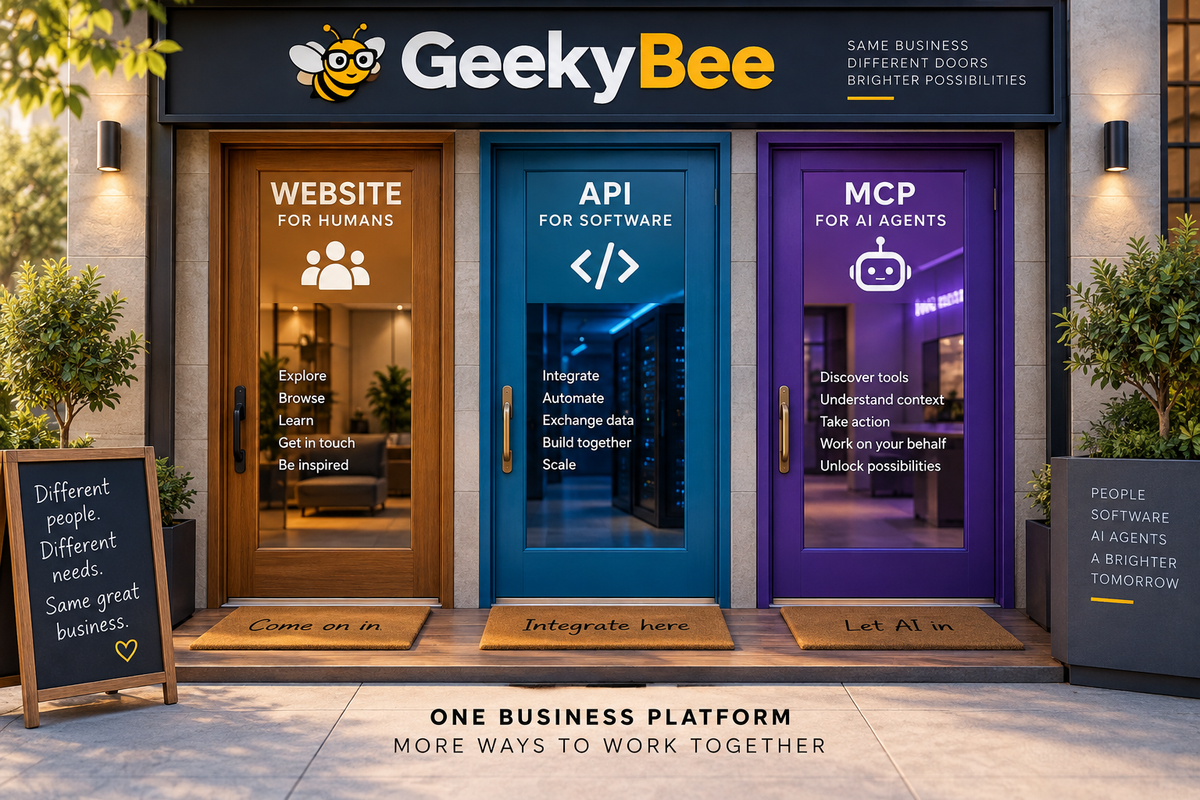
A company might eventually have several: a website for humans, an API for software, and MCP for AI agents.
Should I Build an API First, or MCP First?
For most serious business applications, I'd still design the underlying system properly first: business logic, permissions, data model, authentication, audit trails, then the API. Only then would I expose appropriate capabilities through MCP.
Why? Because your MCP server shouldn't become the business application itself. It should be a controlled interface into capabilities that already exist. That gives you something extremely valuable: one business platform, multiple interfaces. Your website can use it. Your mobile app can use it. Your customers' systems can use it. Your internal automation can use it. And AI agents can use it too.
What Happens When MCP Meets Voice AI?
Now we're entering particularly interesting territory.
Imagine calling a company and saying: "I've got an appointment next Wednesday but something's come up — can you move it to Friday morning, around ten, and use the same card for the deposit?"
The Voice AI understands the conversation. MCP exposes the available business capabilities. The underlying APIs perform the actions. The chain looks something like:
Customer → Voice AI → Reasoning Model → MCP Tools → Business APIs → CRM / Booking / Payments
And all the customer experiences is a conversation. This is why I don't see MCP as simply another developer technology — it's part of a much larger shift in how humans, AI and software interact.
What Should Businesses Actually Be Doing Now?
Don't rush out and build an MCP server simply because everyone on LinkedIn has suddenly discovered the acronym.
Instead, ask a more useful question:
What capabilities does our business have that an AI agent could use?
Start mapping them — customer management, bookings, quotes, orders, payments, documents, inventory, property searches, analytics, support, reporting. Then ask: which of these could safely be exposed as AI tools?
That exercise alone is incredibly valuable. Even if you don't implement MCP tomorrow, you're starting to design your business for a world where AI agents don't simply read information — they do things.
API vs MCP in 30 Seconds
If you remember nothing else from this article, remember this:
- API — allows software to communicate with software.
- MCP — provides a standard way for AI systems to discover and use tools, data and capabilities.
- Do we need APIs? Absolutely.
- Do we need MCP? Increasingly, yes — particularly for AI-enabled applications.
- Does MCP replace APIs? No.
- Which is better? Wrong question.
- What should modern software increasingly support? Both.
The Bigger Picture
We've spent decades building software around graphical interfaces — buttons, menus, forms, dashboards. APIs then let software bypass those interfaces and talk directly to other software. AI introduces another layer entirely: now we can express intent.
Instead of clicking through six screens, we can simply say: "Find my outstanding invoices from last month, check whether they've been chased, and draft follow-ups for anything more than 14 days overdue."
The AI works out what needs to happen. MCP helps it discover what tools are available. APIs and business logic actually make things happen.
That's the important shift — moving from humans operating software to humans expressing intent, and software working out how to fulfil it.
MCP isn't the whole story. Neither are APIs. But together, they're part of the infrastructure making that future possible. And for businesses building software today, that's worth paying attention to.
One Final Thought
For years, businesses asked: "Do we need a website?" Then: "Do we need an API?"
We're rapidly approaching the next question:
"Can an AI agent do business with us?"
That may turn out to be a much bigger question than MCP itself.
GeekyBee develops bespoke software, AI agents, Voice AI and intelligent business automation designed around how businesses actually work — not around the latest technology acronym. Get in touch if you want to work out what your business's answer to that last question should be.
Frequently Asked Questions
1. What is the difference between an API and MCP?
An API (Application Programming Interface) allows one software application to communicate with another using predefined requests and responses. MCP (Model Context Protocol) provides a standard way for AI applications and agents to discover and use external tools, data and capabilities. Put simply: APIs are primarily designed for software-to-software integration, while MCP is designed to make external capabilities easier for AI systems to discover and use.
2. Does MCP replace APIs?
No. MCP does not replace APIs. In fact, an MCP server will often use existing APIs behind the scenes. The API provides access to the underlying application or business functionality, while MCP provides an AI-friendly way of exposing selected capabilities. Many modern platforms are therefore likely to support both APIs and MCP.
3. Which is better: API or MCP?
Neither is inherently better because they solve different problems. APIs are ideal for predictable, structured integrations between applications. MCP is particularly useful when AI agents need to discover available tools and decide which capabilities to use. A well-designed AI-enabled platform may use MCP and APIs together.
4. What is an MCP server?
An MCP server exposes tools, resources or other capabilities that an AI application can discover and use through the Model Context Protocol. For example, a property platform might expose MCP tools for searching properties, retrieving planning information, calculating rental yield and analysing an investment opportunity.
5. Can MCP work with an existing API?
Yes. This is potentially one of the most useful ways to introduce MCP into an existing application. Rather than rebuilding the software, developers can create an MCP layer that exposes selected functionality from existing APIs. Existing websites, applications and integrations can continue using the API while AI agents access appropriate capabilities through MCP.
6. Do I need an MCP server for my business?
Not necessarily. A simple website or application may gain little from MCP today. However, if your business operates a SaaS platform, CRM, booking system, analytics platform, property system, knowledge base or other software containing useful data and business functions, it is worth considering whether those capabilities could eventually be used by AI agents.
7. Is MCP only for AI agents?
MCP was specifically designed around connecting AI applications and models to external tools and context, so AI is central to its purpose. It becomes particularly powerful with AI agents because an agent can discover available tools, determine which ones it needs and potentially perform several actions to complete a user's request.
8. Is MCP secure?
MCP can be implemented securely, but using MCP does not automatically make an integration secure. Organisations still need appropriate authentication, authorisation, permissions, logging, data isolation and safeguards around sensitive or destructive actions. AI agents should generally receive access only to the capabilities and information they genuinely require.
9. Can ChatGPT and other AI assistants use MCP?
AI applications can support MCP as a way of connecting models with external systems and tools. This makes it possible for compatible AI applications to interact with business systems without every integration necessarily requiring an entirely bespoke tool architecture. Exactly what an AI assistant can access will still depend on the application, permissions and MCP servers made available to it.
10. Should new software be built with both an API and MCP?
For many substantial new SaaS and AI-enabled applications, it is worth designing the architecture with both traditional software integration and AI-agent access in mind. The underlying business logic should remain independent of either interface. APIs can expose capabilities to conventional applications and integrations, while MCP can expose carefully selected capabilities to AI systems. This creates one core business platform that can serve humans through a website or app, software through APIs, and AI agents through MCP.