Case Study - Beyond the Image: How GeekyBee VR Helped Sapien Bring Decision-Making Under Pressure to Life
What began as a request for 360-degree photography became an interactive flight simulator experience, immersive video and bespoke software. Discover how GeekyBee VR worked with Sapien to turn a simple idea into something far more ambitious.

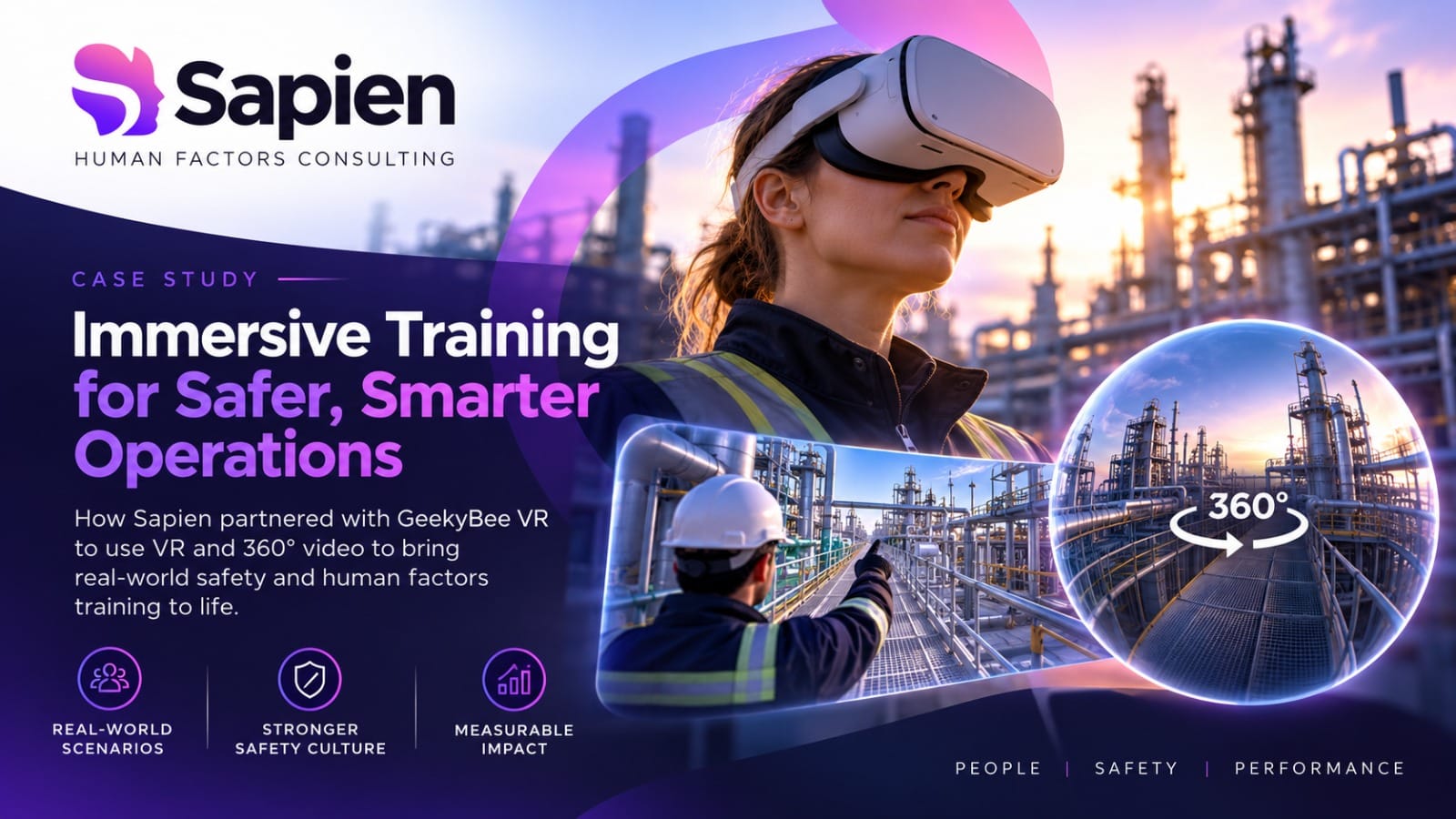
What began as a request for a few 360-degree photographs developed into an interactive flight simulator experience, a thought-provoking 360-degree marketing video and bespoke software that brought the whole experience together.
Here's how working collaboratively helped us take Sapien's original idea considerably further.
The client: Sapien Human Factors Consulting
What can business leaders learn from airline pilots about making decisions under pressure?
Quite a lot, as it turns out.
Sapien Human Factors Consulting helps organisations develop stronger leaders, improve teamwork and make better decisions in high-pressure environments.
Its training draws on decades of experience in commercial aviation, where pilots regularly face situations that demand clear thinking, effective communication, teamwork and the ability to make important decisions under pressure.
Much of this comes from the discipline of Human Factors, which examines how people behave, communicate and make decisions, particularly when circumstances become challenging.
And these lessons extend well beyond aviation.
Whether someone is managing a business crisis, responding to an unexpected operational problem or making decisions with significant consequences, the ability to recognise emotional responses, assess the facts and concentrate on what can actually be controlled is enormously valuable.
Sapien brings these principles to life through a combination of classroom learning and practical experiences, including sessions in a professional flight simulator.
The objective isn't to teach business executives how to fly an aircraft. It's to place them in unfamiliar, challenging situations where they can:
- experience their own reactions;
- understand how pressure affects their judgement;
- develop techniques they can apply in their professional lives.
And it was this rather unusual training environment that brought GeekyBee into the picture.
The original brief: A little more pizzazz
Our involvement began through Izzy, who runs Izzy Gets Stuff Done, the creative agency responsible for developing Sapien's website.
Izzy wanted something distinctive. Something that would make the website stand out, capture visitors' attention and give prospective customers a better understanding of the flight simulator experience.
Her initial idea was relatively straightforward: could we produce a couple of 360-degree photographs of the simulator so visitors could look around the cockpit?
Of course we could.
But just because we can produce something doesn't necessarily mean it's the best way to achieve what the client wants.
We wanted to understand what Izzy was really trying to accomplish. Was it simply to show visitors what the simulator looked like, or could we use the technology to communicate something about Sapien's training?
The word Izzy used was pizzazz.
And that got us thinking:
- A beautifully photographed environment might attract someone's attention, but we wanted to create something that would encourage visitors to stop, explore and remember what they'd experienced.
- The real opportunity wasn't simply to produce a 360-degree photograph. It was to turn that photograph into something people could interact with.
And that changed the direction of the project.
Looking beyond the photograph
A flight simulator cockpit is a fascinating environment, filled with instruments, displays, switches, controls and warning systems. To somebody unfamiliar with aviation, it can look extraordinarily complicated.
But every instrument has a purpose.
As we considered how to bring Sapien's training philosophy into the experience, we began exploring connections between the aircraft's controls and the skills the company teaches:
- Take the altimeter, which measures altitude. It could provide a starting point for discussing situational awareness, recognising changing circumstances and understanding the importance of monitoring progress.
- The attitude indicator, which shows the aircraft's orientation, offered a connection to maintaining perspective, keeping a level head and understanding your current situation before making decisions.
- Even the throttles, which control engine power, could introduce ideas about managing responses, making appropriate adjustments and knowing when to act under pressure.
These weren't intended to be literal aviation lessons. They were creative ways of connecting the simulator environment with the principles Sapien wanted visitors to understand.
So we proposed making the cockpit interactive:
- Rather than simply looking around, visitors could explore selected instruments and controls through interactive hotspots positioned within the 360-degree photograph.
- Hovering over a hotspot could reveal additional information, while clicking could open supporting content, play a video, navigate to a relevant website page or provide access to a contact form.
This would turn the cockpit into an alternative way of navigating Sapien's website, allowing visitors to discover its services through the environment in which its training takes place.
And it introduced an element of curiosity. What does that switch do? What happens when I click that instrument?
Instead of following a conventional website menu, visitors could explore the cockpit and discover information for themselves.
The photograph was no longer simply something to look at. It had become part of how visitors experienced the website.
When the software doesn't exist, build it
There was, however, a technical challenge.
Sapien's website was being developed in Wix, so whatever we created needed to work within that environment.
We also needed a way to position interactive hotspots over specific instruments and controls within a 360-degree photograph, ensuring they remained accurately positioned as visitors explored the cockpit.
That might sound straightforward, but consider a hotspot placed over the aircraft's throttles:
- As someone rotates the panoramic image, the throttles move across the screen. The hotspot needs to move with them, remaining attached to the correct control regardless of which direction the visitor looks.
- It can't drift away, remain fixed in the middle of the screen or appear in the wrong place when the visitor returns to that part of the cockpit.
We investigated the available tools but couldn't find a solution that provided the functionality and integration we needed.
Rather than compromise the concept, we decided to develop the missing functionality ourselves:
- Using JavaScript, we created bespoke software that allowed us to position interactive hotspots within panoramic imagery, associate them with different actions and keep them correctly aligned as visitors navigated the scene.
- The solution also needed to be flexible enough to support different types of content while working within the existing Wix website.
The underlying technology wasn't new. The challenge was bringing the different elements together into a reliable, practical solution that delivered the experience we'd envisaged.
And that reflects something I've always believed about technology: Just because an existing application can't do something doesn't mean the computer can't do it.
Sometimes the answer is to find a different application. Sometimes it's to combine several technologies. And sometimes it's to write the software yourself.
The important thing is to let the objective determine the technology, rather than allowing the limitations of an existing product to determine what's possible.
Bringing the cockpit to life
With the technical challenges resolved, we could concentrate on bringing the experience together.
GeekyBee VR handled the complete immersive production, from capturing the 360-degree photography to developing the interactive elements and delivering the finished experience.
We photographed the simulator and its surroundings, creating an environment that allowed website visitors to explore the location, move towards the aircraft simulator and eventually find themselves inside the cockpit.
Once there, visitors could look around the flight deck and interact with selected instruments and controls, discovering information about Sapien's services through the environment itself.
It offered a different way to experience the website. Rather than relying entirely on conventional pages and navigation menus, visitors could explore a setting directly connected to Sapien's training and discover content as they went.
Alongside the immersive photography and interactive development, we also captured conventional video footage for use within the wider project.
Throughout the process, we worked closely with Izzy to ensure everything could be incorporated into the Wix website she was developing.
It was a genuinely collaborative project. Izzy brought the creative direction and website design, Sapien contributed its aviation expertise and understanding of Human Factors, and GeekyBee VR provided the immersive production and technical development needed to bring the ideas together.
Rather than working to a rigid specification, we explored possibilities together, discussed what would work and developed the experience as the project progressed.
And those conversations led to an idea that would take us beyond interactive photography altogether.
What would you do?
While working with Sapien, we began discussing how 360-degree video could communicate the principles behind its training in a more immediate, engaging way.
The flight simulator gave us an opportunity to try something rather different.
What if we created a scenario in which someone suddenly found themselves facing an emergency? Not watching it unfold on a conventional screen, but experiencing it from inside the cockpit.
We suggested filming a simulated aircraft emergency:
- Sapien's team configured the simulator for a dangerously unstable approach towards an airport. The aircraft would be descending too quickly, incorrectly aligned with the runway, with warning systems sounding as the ground approached.
- We positioned the 360-degree camera inside the cockpit and prepared the recording.
Then everyone left.
Both pilot seats were empty.
The camera continued recording as the simulated aircraft descended towards the ground, with automated warnings demanding corrective action.
The result was an unusual experience. Viewers could look around the cockpit, examine the instruments, see the empty pilot seats and hear the increasingly urgent warnings.
And they were confronted with one simple question.
What would you do?
It's easy to imagine the thoughts that might start racing through someone's mind. Where are the pilots? How did I end up here? What happens if I make the wrong decision?
All perfectly understandable questions, but none of them addresses the immediate problem.
The aircraft is approaching the ground. What information is available? What can be controlled? And what needs to happen first?
The point wasn't whether someone without flying experience could land an aircraft. It was to make them consider how quickly their attention might shift towards things beyond their control, rather than concentrating on the decisions still available to them.
This is where the experience connects with Sapien's approach to Human Factors.
The objective isn't to eliminate emotion or pretend that pressure doesn't affect us. It's to recognise how our reactions can influence our judgement and learn to concentrate on the information and actions that matter.
The scenario encourages viewers to consider the difference between reacting to everything happening around them and identifying what they can actually do about the situation.
And the choice of 360-degree video was deliberate:
- In conventional video, the filmmaker decides where the audience looks. With 360-degree video, viewers can explore the environment for themselves, deciding which instruments to examine and where to direct their attention.
- For an experience designed to provoke thought about situational awareness and decision-making under pressure, that distinction is particularly relevant.
The finished emergency video became a separate marketing asset for Sapien, created for use in its direct communications with businesses.
Rather than simply demonstrating the flight simulator, it challenged prospective corporate clients to consider how they might respond under pressure, opening up a conversation about the skills Sapien helps organisations develop.
More than one way to use immersive technology
One of the most interesting aspects of the Sapien project was how we used immersive technology to achieve several quite different objectives:
- The virtual walkthrough helped prospective participants familiarise themselves with the simulator environment before attending a training session, making an unfamiliar setting feel more approachable.
- The interactive cockpit turned that environment into another way of exploring Sapien's services, encouraging visitors to discover information through the instruments and controls around them.
- The simulated emergency took a different approach altogether. Rather than showing people what the simulator looked like, it used the environment to challenge how they might think and respond under pressure.
Alongside these experiences, conventional video footage provided additional material for Sapien's website and marketing.
Each element had a purpose beyond simply looking impressive.
And that's an important distinction.
Immersive technology is most valuable when it helps people understand, explore or experience something in a way that conventional photography or video cannot achieve quite as effectively.
The technology itself isn't the objective. It's what we can accomplish with it that matters.
The client relationship: Understanding before agreeing
One of the things we particularly enjoyed about working with Sapien was the way its team approached new ideas.
They didn't automatically agree with every suggestion. They asked questions, wanted to understand our reasoning and took an active interest in what the technology could achieve.
Why would an interactive cockpit be more effective than a conventional photograph? What could 360-degree video offer that standard video couldn't? And, most importantly, what would visitors actually gain from the experience?
Those are exactly the questions we like clients to ask.
Because a good idea should survive being questioned.
We discussed the possibilities, explored different approaches and considered how each might contribute to Sapien's objectives. It wasn't about convincing the client to use more technology. It was about finding the right way to communicate what made its training different.
The simulated emergency was a particularly good example of that collaboration:
- We brought the creative concept, cameras and immersive production expertise, but recreating a convincing aviation emergency required Sapien's specialist knowledge.
- Their team configured the simulator, we handled the filming, and together we produced something that neither party could have created in quite the same way independently.
That's the kind of working relationship we value at GeekyBee. One where ideas can be questioned, improved and developed through the different perspectives everyone brings to the project.
Sometimes the best results come not from following the original brief exactly, but from being willing to explore what else might be possible.
The outcome: Going beyond the original brief
What began as a request for a handful of 360-degree photographs became a much broader creative and technical project:
GeekyBee VR delivered a series of immersive virtual tours, an interactive cockpit experience supported by bespoke JavaScript functionality, a simulated aircraft emergency filmed in 360 degrees for corporate marketing, and additional conventional video footage.
- Each element served a different purpose, but together they gave Sapien new ways to introduce its training, engage prospective clients and familiarise course participants with the flight simulator environment.
The virtual walkthrough and cockpit experience also became part of Sapien's own website resources, allowing prospective participants to explore the simulator before attending a session.
- For people who have never stepped inside a flight simulator, being able to see the environment beforehand can help make the experience feel less unfamiliar.
The interactive cockpit offered another way to discover Sapien's services, while the emergency video provided a thought-provoking introduction to the importance of situational awareness and decision-making under pressure.
The Sapien team were enthusiastic about the finished work and particularly pleased with how far the project had developed beyond the original brief.
What started as a relatively simple photography request had grown into a collection of immersive experiences, marketing assets and bespoke software that Sapien could use in different ways.
And the project produced something else that would prove useful well beyond Sapien itself.
From a client challenge to free 360-degree tools
One of the unexpected outcomes of the Sapien project was that solving its technical challenges led us to develop software that could be useful well beyond the original brief.
We've already discussed the interactive hotspots, but another challenge involved aligning the panoramic photographs themselves:
- A flight simulator cockpit is full of straight lines. Instrument panels, display surrounds and structural features all provide visual references, making even small alignment errors noticeable.
- If the panorama isn't correctly aligned, those lines can appear tilted or distorted, affecting the overall quality of the experience.
To address this, we developed software that could automatically calculate and correct the alignment of a panoramic image using a horizontal or vertical reference line.
For example, we could draw a line along the top of an instrument panel to indicate where the image should be level. The software would calculate the necessary adjustment and automatically correct the alignment. The same process could be applied using vertical features.
What previously required careful manual adjustment could now be achieved by identifying a reference line and letting the software handle the correction.
Alongside the interactive hotspot functionality, this work contributed to a collection of browser-based tools for creating and editing immersive imagery.
And rather than keeping those tools exclusively for GeekyBee's own projects, we decided to make them freely available.
If you work with 360-degree panoramic images, you can explore the tools here: Equirecover Pano360Align
What started as a practical challenge on one client's project had become something with a wider application.
For us, that's one of the most satisfying aspects of bespoke software development.
Sometimes the value of solving a problem extends well beyond the project that prompted it.
Symbiosis: The GeekyBee approach
If we had to choose one word to describe how we prefer to work with clients, it would be symbiosis.
We want to work with people, not simply for them.
A client might approach us with a particular technology in mind, whether that's a website, an AI receptionist, a virtual tour or a piece of bespoke software. But before deciding how to build it, we want to understand what they're actually trying to achieve.
Sometimes that means questioning the original brief, exploring alternatives or introducing possibilities the client may not have considered.
That's not a criticism of the client. It's part of the value a technology specialist should bring to the relationship.
After all, we wouldn't expect our accountant simply to add up receipts and invoices without applying their professional knowledge to the wider financial picture. Why should we expect anything less from a technology consultancy?
We believe clients should expect ideas, informed advice and a willingness to challenge an approach when there's a better alternative. Equally, we need to listen, understand their business and recognise the expertise they bring to the project.
The Sapien experience demonstrated how valuable that exchange can be. What started as a relatively simple request became something considerably more ambitious because everyone was prepared to contribute ideas and explore the possibilities.
That doesn't mean every suggestion should be pursued or every technical obstacle overcome. Sometimes the simplest solution really is the best one.
But when an idea offers genuine value and the technology makes it achievable, we believe it's worth exploring.
That's what symbiosis means to us: combining different perspectives and expertise to achieve something better than either party might have developed alone.
The bigger picture: Technology should follow the idea
Technology is advancing at an extraordinary pace. AI-assisted software development and increasingly accessible creative tools are making it possible to explore ideas that might once have required substantial development resources.
But while the tools are changing, the importance of understanding what we're trying to achieve remains the same.
The Sapien project began with a relatively simple request: a few 360-degree photographs to make a website more interesting.
By looking beyond that initial requirement, we found opportunities to create interactive experiences, communicate the principles behind Sapien's training and develop bespoke functionality that eventually became useful beyond the original project.
We didn't set out to write custom panoramic software. We set out to create something memorable, and developing that software became part of making the idea work.
That's an important distinction.
The best technology projects don't begin with a list of what the software can do. They begin with a conversation about what we want to achieve.
And sometimes, the most valuable contribution a technology partner can make is simply to ask:
Have you thought about doing it this way?
Explore the Sapien project
See how GeekyBee used immersive photography, interactive development and 360-degree video to support Sapien's training and marketing.
Visit Sapien Human Factors Consulting
Discover Sapien's approach to leadership development, Human Factors and decision-making under pressure.

Explore Sapien's virtual flight simulator walkthrough
Step inside one of the immersive 360-degree environments created by GeekyBee VR.
Explore another Sapien 360-degree experience
Discover another perspective on the simulator environment through our immersive photography.
View Sapien's training resources
See how Sapien presents its simulator experiences and supporting resources to prospective participants.
Have an idea that needs something a little different?
At GeekyBee, we combine creative thinking with immersive technologies, AI and bespoke software development to help businesses turn ideas into practical solutions.
Whether you're considering an interactive virtual tour, 360-degree photography, immersive video or an application that doesn't quite fit the capabilities of existing software, we'd be interested in hearing what you're trying to achieve.
You don't need to arrive with a detailed technical specification. Sometimes the most interesting projects begin with a conversation.