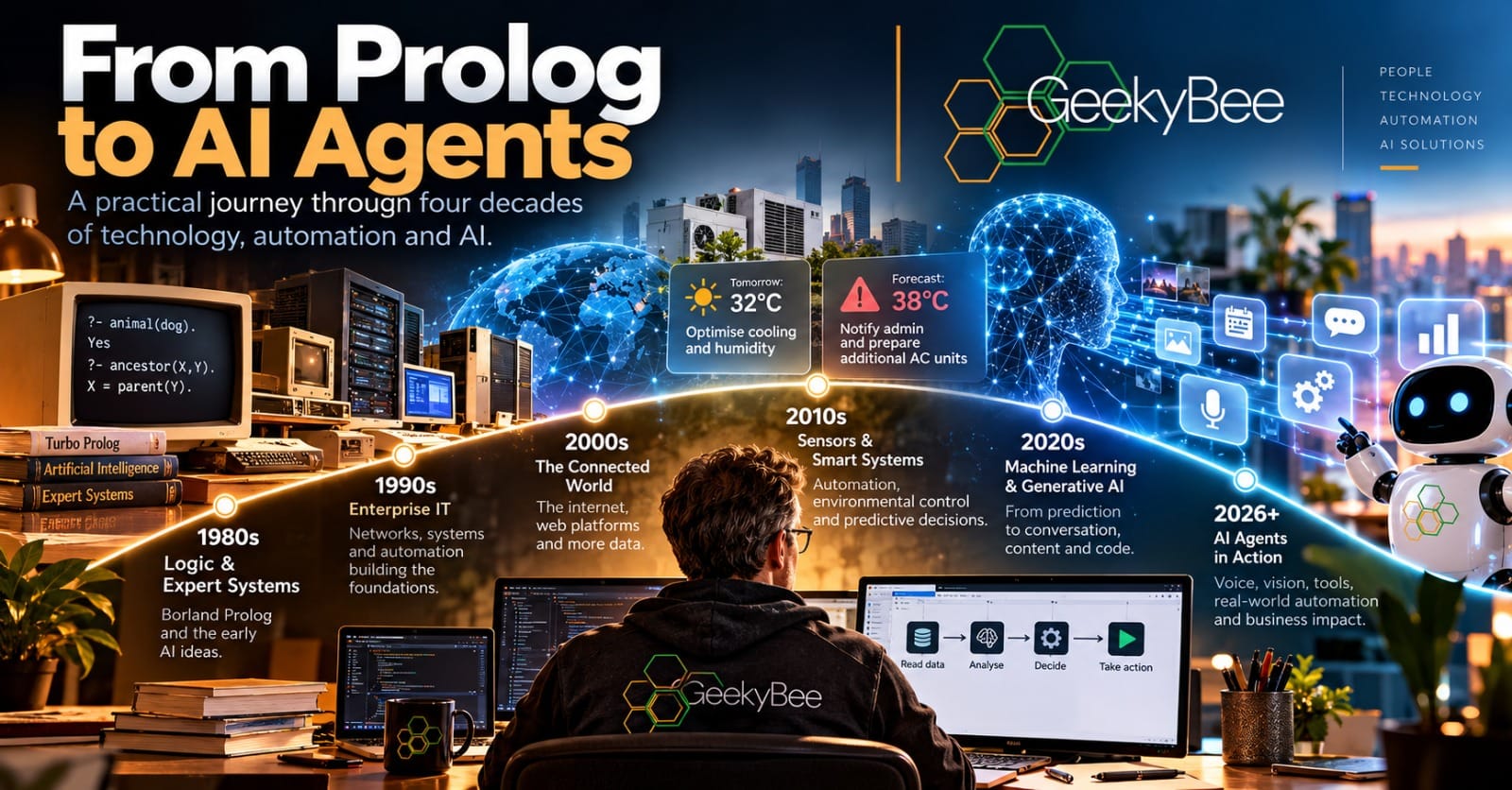
I started with Turbo Prolog in 1986. AI has reinvented itself four times since.
From Turbo Prolog in 1986 to autonomous AI agents in 2026, I've watched artificial intelligence reinvent itself for forty years. Through breakthroughs, false dawns and spectacular failures, this is the story of how AI finally became useful, accessible and capable of helping us build software.

The potted history of AI goes something like this: it started in 1956, not much happened, then ChatGPT. That version is tidy and almost entirely useless, because it skips one of the most interesting things about this field. AI has repeatedly changed its approach to what intelligence actually is and how machines might reproduce it:
- Logic and rules gave way to statistics;
- Statistics led to advances in machine learning and neural networks;
- Neural networks transformed what computers could do with language, vision and speech and;
- Now those models are being connected to tools, memory and everyday software, allowing them to move beyond describing things and start doing them.
Four major shifts, each bringing new capabilities, new expectations and, inevitably, new limitations.
My own introduction to AI came in 1986 with Turbo Prolog, at a time when symbolic AI was still a major force in the industry. What I didn't appreciate then was that another approach was already gathering momentum, one that would eventually change almost everything about how we develop and use artificial intelligence.
The problems haven't changed much
AI's generally accepted starting point is 1956, although the thinking behind it goes back further.
In 1950, Alan Turing published Computing Machinery and Intelligence. Rather than getting bogged down in defining what it means for a machine to “think”, he proposed something more practical: the imitation game. Could a machine hold a conversation convincingly enough that someone questioning it couldn't reliably distinguish it from a human?
Instead of arguing about the definition of intelligence, he proposed a way of testing it.
Six years later, John McCarthy, Marvin Minsky, Nathaniel Rochester and Claude Shannon organised the Dartmouth Summer Research Project on Artificial Intelligence. Their original 1955 proposal was remarkably ambitious. They believed that aspects of human intelligence could be described precisely enough for a machine to simulate them. Language, reasoning, abstraction, problem-solving and even machines improving themselves were all part of the discussion.
What's interesting is that seventy years later, we're still working on many of those same problems. We have vastly more computing power, enormous amounts of data and considerably more sophisticated techniques, but the fundamental questions haven't changed nearly as much as the technology used to tackle them.
Rules versus learning
Early AI was largely built around the idea that intelligence could be reproduced using facts, logic and rules. If we tell a computer that all mammals are warm-blooded, and that a dog is a mammal, it should be able to work out that a dog is warm-blooded. Simple enough, and for a while this looked like the obvious way forward.
This became known as symbolic AI. Researchers such as Allen Newell and Herbert Simon developed programs that could solve logical problems, prove mathematical theorems and play games. These were impressive achievements at a time when computers were still relatively primitive.
But another approach was developing alongside it.
In the late 1950s, Frank Rosenblatt introduced the perceptron, an early form of artificial neural network. Rather than programming every rule into a computer, the idea was to let it learn patterns from examples. Instead of telling a machine exactly how to recognise something, you could train it using data and allow it to adjust its own internal calculations.
Two very different approaches to the same problem: do we teach computers the rules, or do we teach them how to learn?
For a long time, symbolic AI had the advantage. Computers had limited processing power and memory, and rules-based systems worked well when the problem was clearly defined.
Give a computer a set of facts and rules, and it can produce remarkably consistent results. The difficulty comes when those rules don't cover every possibility.
And as anyone who's spent time developing software will know, the real world has a habit of producing exceptions nobody thought to include.
The world turns out to be messy
The early predictions for AI were ambitious, to say the least. Computers were solving mathematical problems, playing games and demonstrating logical reasoning. Some researchers believed machines with human-level intelligence might be only ten or twenty years away.
Unfortunately, the real world proved considerably more complicated:
- Human language is full of ambiguity.
- Recognising objects and understanding images proved far more difficult than expected.
- Even common sense, something we take for granted, involves an enormous amount of knowledge that we acquire through everyday experience without necessarily being taught.
- Then there was the computing power. Problems that looked relatively straightforward could require examining millions of possible combinations, quickly overwhelming the hardware available at the time.
Progress was slower than promised, confidence fell, and funding was cut. This became known as the first AI winter, a period during the 1970s when enthusiasm and investment in artificial intelligence declined.
But describing it as a "winter" suggests that AI research somehow stopped. It hadn't.
Edward Feigenbaum, one of the pioneers of expert systems, later challenged the way these periods were described. Expert systems were developing during one supposed winter, while machine learning continued advancing during another.
What really changed was where the attention and investment went.
And that's a pattern we've seen repeatedly throughout the history of technology. One approach fails to deliver on its promises, enthusiasm disappears, and another quietly develops until it's ready to take centre stage.
AI didn't disappear during its winters. It continued evolving, often away from the headlines.
Teach it what the experts know
The answer to a machine that cannot know everything was to stop asking it to. Instead, concentrate on making it exceptionally knowledgeable about one particular subject. That was the thinking behind expert systems, and it was one of the first approaches to AI that demonstrated genuine commercial value.
- Stanford's DENDRAL project began in 1965, using specialist knowledge to help scientists identify molecular structures. Edward Feigenbaum was one of the researchers involved and became a leading figure in expert systems.
- Another Stanford project, MYCIN, applied similar principles to identifying bacterial infections and recommending treatments. In controlled evaluations, its recommendations compared favourably with those of medical specialists.
What made these systems interesting wasn't simply the knowledge they contained, but how that knowledge was organised.
Rather than hard-coding every piece of expertise into the software, developers could build a separate knowledge base of facts and rules. An inference engine would then use that information to reach conclusions. In principle, you could update the knowledge without having to rewrite the underlying software.
And if that sounds familiar, there's a good reason.
Today, we're connecting AI models to company documents, databases and internal knowledge using techniques such as retrieval-augmented generation (RAG). The technology works very differently, but the underlying business objective is remarkably similar: give a system access to an organisation's knowledge so it can use that information to answer questions and support decisions.
The challenge hasn't disappeared either. You still need:
- accurate information,
- a sensible way to organise it, and
- a process to keep it up to date.
Forty years ago, that meant maintaining knowledge bases and their rules. Today, it might mean ensuring an AI agent is working from the correct company policies, current prices or latest procedures.
The technology has changed considerably. The importance of getting the information right hasn't.
1986: where I come in
My own introduction to AI came in 1986 with Turbo Prolog, a programming language developed by the Danish Prolog Development Centre and marketed by Borland. Version 1.0 appeared in 1986, and the technology eventually evolved into Visual Prolog, which is still available today.
There was no ambiguity about what it was intended for. The accompanying literature described Prolog as The Natural Language of Artificial Intelligence, and it included examples of expert systems. In September 1986, BYTE magazine suggested Turbo Prolog could represent as significant a development in software design as Turbo Pascal had been a few years earlier. That was quite a statement at the time.
What made Prolog interesting was how differently it approached programming.
With languages such as BASIC, Pascal or C, you generally told the computer what to do and in what order. Prolog turned that approach around. You provided facts, defined relationships and established rules. Then you asked a question and let the software work out the answer.
It used techniques called unification and backtracking to explore possible solutions. It could be remarkably effective, but when it failed, you often had no idea why, which was character-building!
Looking back, there's an interesting similarity with the AI systems we're developing today. We provide information, establish objectives and give the technology a degree of freedom to work out how to achieve them. The underlying methods are completely different, but the principle of describing what you want rather than every step needed to achieve it feels remarkably familiar.
What I find particularly interesting is the timing.
Turbo Prolog arrived in 1986, the same year David Rumelhart, Geoffrey Hinton and Ronald Williams published their influential research on backpropagation. Their work demonstrated how multilayer neural networks could be trained by adjusting connections in response to errors.
So, while I was sitting in front of a computer, loading Turbo Prolog from a 5.25-inch floppy disk and learning to think in facts and rules, another branch of AI was developing methods that would eventually underpin much of today's machine learning.
At the time, these were two very different approaches to artificial intelligence. Nearly forty years later, we're increasingly bringing them together, combining neural networks with conventional software, structured information and explicit business rules.
It's an interesting reminder that the ideas shaping modern AI didn't all appear in the last few years. Some have been developing alongside one another for decades.
The second crash, and the sideways move
Expert systems became commercially successful, attracting considerable investment from businesses that saw an opportunity to automate specialist knowledge and decision-making. Companies spent heavily developing knowledge bases and purchasing specialised hardware, including Lisp machines, computers designed specifically for the programming languages commonly used in AI research.
For a while, the future looked promising.
Then the maintenance bill arrived:
- Thousands of rules turned out to be expensive to maintain.
- Extracting knowledge from experts was slow and complicated, not least because people aren't always able to explain exactly how they arrive at a decision.
- Rules could also interact in unexpected ways, and changing one part of a system sometimes created problems somewhere else.
Anyone who's worked in software development for more than a fortnight will recognise the problem. Building a complicated system is often easier than keeping it working reliably as requirements change.
As costs increased and expectations weren't met, confidence and investment declined. By the late 1980s and early 1990s, AI had entered what became known as its second winter.
And once again, AI didn't die. It moved sideways. Rather than trying to model intelligence through thousands of explicitly programmed rules, researchers began asking a different question: what if computers could learn useful patterns and behaviour directly from data?
That question would help shape the next major chapter in AI's development.
The 1990s: AI stops calling itself AI
One of the more interesting periods in AI's history runs from the early 1990s into the 2000s. The technology was becoming increasingly useful, yet many companies seemed reluctant to call it artificial intelligence.
Instead, we heard about machine learning, pattern recognition, data mining, speech recognition, statistical modelling, computer vision and recommendation engines. These were all areas closely associated with AI, but after two periods of inflated expectations and disappointing commercial results, the term itself had become something of a liability.
- Calling your product AI might raise a few eyebrows. Calling it predictive analytics sounded like something a finance director might actually sign off.
Behind the terminology, however, some important developments were taking place. Bayesian methods, support-vector machines, decision trees and increasingly capable neural networks were helping computers recognise patterns, classify information and make predictions from data.
- The significant change was that researchers and businesses were concentrating less on reproducing human intelligence and more on solving specific, measurable problems.
Could a system identify fraudulent transactions, predict equipment failures or recognise patterns in customer behaviour? These were practical questions with testable, measurable results.
I think this was one of the most important changes in AI's development, because the focus shifted from making machines think to making machines predict.
Thinking is a philosophical argument with no agreed finish line. Prediction is a measurable engineering problem with a number attached, and it turned out to be commercially enormous.
Deep Blue, AlexNet, AlphaGo
Three important moments in AI's history, each demonstrating something quite different about what computers could achieve.
In 1997, IBM's Deep Blue defeated world chess champion Garry Kasparov. It was a remarkable achievement, although Deep Blue wasn't thinking about chess in the way a human player would. It combined enormous computing power with sophisticated search techniques and chess evaluation, examining millions of possible positions to determine its next move.
- The important lesson wasn't that computers had suddenly learned to think. It was that combining powerful hardware with well-designed algorithms could produce results previously associated with human intelligence.
Before the next major breakthroughs, however, something else happened that would change AI's future.
The internet exploded.
- Businesses digitised their records, millions of people began sharing information and photographs online, and the amount of available data grew enormously. At the same time, storage became cheaper, processors became faster, graphics processing units (GPUs) developed rapidly, and cloud computing made substantial computing resources more accessible.
Without necessarily realising it, we were creating much of the infrastructure and data that would make the next generation of AI possible.
And that's an important part of the story that often gets overlooked. Many of the underlying ideas behind neural networks had existed for decades. What changed was that we now had the datasets and computing power needed to process them.
AI history is not only a history of algorithms. It is a history of algorithms finally meeting enough silicon.
That brings us to 2012, when Alex Krizhevsky, Ilya Sutskever and Geoffrey Hinton demonstrated AlexNet, a deep neural network trained to recognise objects in photographs.
- AlexNet dramatically improved ImageNet's image-recognition benchmark, showing what deep neural networks could achieve with sufficient data and GPU processing power. It was a turning point for modern deep learning, with advances in vision, speech recognition and translation following quickly.
- Neural networks stopped being the promising idea that had repeatedly disappointed. They worked.
Then, in March 2016, Google's DeepMind achieved another milestone when AlphaGo defeated world Go champion Lee Sedol by four games to one.
- Unlike Deep Blue, which relied heavily on searching possible moves using chess-specific evaluation, AlphaGo combined deep neural networks, search and reinforcement learning. It initially learned from games played by humans, then improved through playing against itself.
- During the match, AlphaGo made moves that startled professional players. It wasn't simply following strategies written by programmers. It had learned to find solutions that even human experts hadn't anticipated.
And that's what made AlphaGo so significant.
Early symbolic AI concentrated on giving computers the knowledge and rules needed to reach conclusions. Machine learning introduced another possibility: rather than programming every answer, could we create systems capable of discovering useful solutions for themselves?
2017: eight researchers and one paper
In June 2017, eight Google researchers published Attention Is All You Need, introducing the Transformer. Instead of processing language sequentially through recurrent networks, it used a mechanism called attention to identify relationships between words and process information in parallel. This made training larger models considerably more efficient.
It's difficult to overstate what followed. Transformers became the foundation for GPT, BERT, Claude, Gemini and many of today's leading coding models. A paper largely concerned with machine translation turned out to be the foundation of an industry. Another lateral move, in the finest tradition of the field.
Then researchers discovered something nobody had quite predicted. Make the models bigger, feed them more data and give them more computing power, and their capabilities improved dramatically. New behaviours appeared that hadn't been explicitly programmed. Language completion turned into writing. Writing turned into something that looked a great deal like reasoning.
The practical consequences reshaped the industry. Previously, developers built separate systems for translation, summarisation, programming and other specialised tasks, often requiring different approaches and training. Now, increasingly capable foundation models could handle many of those jobs within a single system.
For anyone running a small software company, that change is the whole ballgame: capability I could never have afforded to build became something I could rent by the token.
30th November 2022: the interface, not the technology
OpenAI released ChatGPT on 30 November 2022. The underlying technology wasn't new. GPT-3 had been available to developers for over two years. What changed was that an ordinary person could type a question and get an answer without an API key, technical documentation, or any understanding of what a token was.
Within months, millions of people who had never knowingly used machine learning were having conversations with it. I suspect historians will rate that as highly as several of the technical breakthroughs behind it.
Technologies don't change society simply because they're invented. They change society when they become usable by people who don't need to understand how they work.
Meanwhile, developments across different areas of AI were accelerating. Language models gained vision. Image generation became remarkably capable. Speech synthesis became unnervingly realistic, while speech recognition improved enormously. Video generation advanced rapidly, and AI coding assistants went from interesting experiments to everyday development tools.
Then models gained access to tools and APIs. Standards such as MCP made those connections easier. Memory allowed systems to retain context, while retrieval connected them to private company data. And suddenly, AI was moving beyond something you consult towards something that could actually do things for you.
Looking back over seventy years, the questions driving AI's development have changed remarkably little, although the approaches have evolved considerably:
|
Era |
The question being asked |
|
1950s |
Can machines reason? |
|
1980s |
Can machines hold expert
knowledge? |
|
1990s |
Can machines predict? |
|
2010s |
Can machines learn
representations? |
|
Early 2020s |
Can machines generate? |
|
Now |
Can machines act? |
That last shift is the one that changes what a software company does for a living.
2026: capable, and still unreliable
The 2026 Stanford AI Index puts numbers on just how quickly things are moving. Industry produced over 90% of notable AI models in 2025. Organisational AI adoption reached 88%. And on OSWorld, a benchmark testing whether AI agents can actually operate computers, task success jumped from roughly 12% to 66%.
Read that last figure properly. On those tests, AI agents succeeded two-thirds of the time. They still failed one task in three.
Extraordinarily capable, and nowhere near dependable. On that benchmark, one task in three still fails. Anyone selling you an autonomous agent without explaining how it handles failure is selling you something else.
Google's own 2026 announcements make the direction clear: AI is moving beyond helping people write and answer questions towards carrying out work on their behalf.
Which lands us, slightly absurdly, back at Dartmouth. Language, reasoning, planning, problem-solving, learning and machine-directed action. The same ambitions, seventy years later. The difference is that we finally have the computing power, data and technology to make a serious attempt at delivering them.
Four decades, one thread
The GeekyBee story is not that we recently became an AI company. It's that I've spent nearly forty years working in technology, watching AI reinvent itself and following developments that could actually do something useful.
My own timeline runs through CP/M, DOS, dial-up, bulletin boards, Novell, Windows, the web, cloud computing and now AI. That's nearly four decades of technological change, including floppy disks that were genuinely floppy. Put Turbo Prolog at the beginning, and the interest in AI stops looking like a recent discovery.
|
Period |
The wider AI world |
What I was doing |
|
|
Expert systems and
symbolic AI; backpropagation gains renewed attention |
Experimenting with Turbo
Prolog, writing facts and rules |
|
1990s |
Machine learning and
pattern recognition gain commercial ground |
Enterprise IT, systems,
networking and integration |
|
2000s |
Growing datasets and
computing infrastructure enable AI at scale |
Web development,
connected systems and digital platforms |
|
2010s |
Deep learning transforms
vision, speech and language processing |
VR, 360° tours and
interactive digital experiences |
|
2020–22 |
Foundation models and
generative AI accelerate |
Automation and AI
experimentation |
|
2023–25 |
LLMs, RAG, multimodal
systems and voice AI become practical business tools |
Conversational AI,
business systems and integrations |
|
2026 |
AI agents increasingly
operate software and execute workflows |
VelvetRope, Ovation, WebMOT, voice agents and
AI-assisted development |
What that looks like in practice today: VelvetRope moderates social comments using AI classification, automated action, human review and calibration, which is a long way from simply generating text. Ovation is an AI-powered back-office platform for touring artists. WebMOT runs automated site diagnostics, including AI-readiness analysis. And we deploy voice AI receptionists, workflow automation and agents working from a company’s own documents and policies.
There's one more change I think is historically underrated, and it's the one I feel most directly. I now build software with AI, not merely software containing AI. Working in Claude Code all day means the model is a participant in construction rather than a feature of the finished product.
For almost the whole history of this field, humans wrote software that contained AI. We've quietly crossed into something else: AI helping humans write software that contains AI. Forty years after I asked a Prolog interpreter to work out whether a dog was warm-blooded, that's a stranger development than anything in the benchmarks.
Research checked and links verified on 5 October 2026.