What Is Bespoke Software — and When Does a Business Actually Need It?
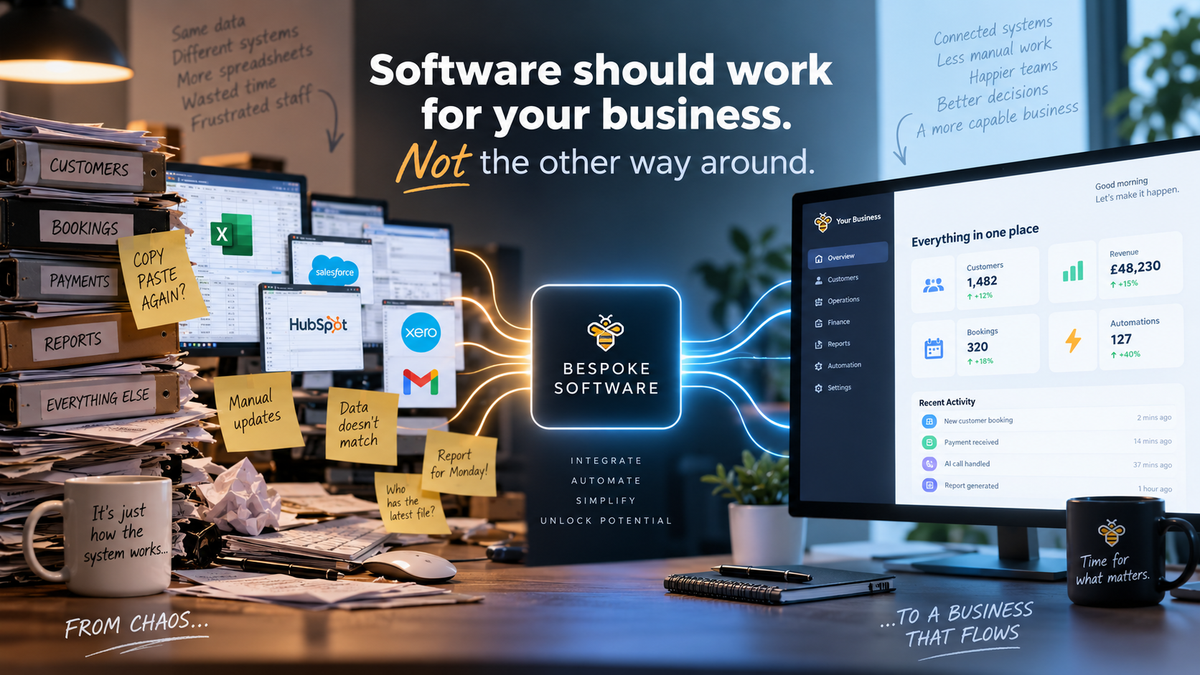
Businesses buy software to solve a problem — then slowly reshape how they work around its limits. Spreadsheets multiply. Staff copy-paste between systems. Someone says "it's just how the system works." That's usually the moment to ask: is it time for bespoke software?

A plain-English guide for business owners tired of working around their own systems
I've been building, implementing and generally messing around with software for the best part of 40 years. One thing hasn't changed in all that time.
Businesses buy software to solve a problem. Then, slowly, they start changing the way they work to accommodate the software.
Someone creates a spreadsheet to fill the gaps. Staff copy information from one system into another. A slightly terrifying collection of macros appears from nowhere. One person develops a process that only they understand.
Eventually, nobody remembers why things are done that way at all.
"It's just how the system works."
That sentence is usually a pretty good sign we should have a conversation. Because sometimes the answer isn't another piece of off-the-shelf software. Sometimes it's bespoke software.
But — and this bit matters — not always.
What Is Bespoke Software, Exactly?
Put simply, bespoke software is software built specifically around the requirements of a particular business, process or problem. Instead of buying a product and adapting your business to fit it, you build the software around the way your business actually needs to operate.
That could mean an entirely new platform. But increasingly, it doesn't.
A bespoke solution might be a relatively small application sitting between systems you already use. It could:
- Connect your CRM to your accounting platform
- Take information arriving by email, read it with AI, and enter the relevant data into another system automatically
- Give customers a self-service portal for something your staff currently handle manually
- Add AI functionality to an existing piece of software
- Replace a tangle of spreadsheets, emails and manual processes with one clean application
So I tend to think of bespoke software less as "building an app" and more as:
Building the missing piece between what your business currently does and what you actually want it to do.
But There's Already Software for Everything
Pretty much. And that's genuinely a good thing.
If somebody has already built a perfectly good piece of software that does what you need for £30 a month, use it. Please. There is no commercial sense in spending thousands recreating something that already exists and works perfectly well. We use plenty of off-the-shelf software ourselves.
The problem starts when you find yourself buying multiple products because none of them quite does what you need.
Product A handles customers. Product B handles bookings. Product C handles payments. Product D produces reports. Product E does some automation.
And then someone in the office spends half their week persuading Products A, B, C, D and E to agree with each other.
At that point, your £30-a-month software isn't really costing £30 a month any more.
The Hidden Cost of Software Is People
This is something businesses often miss when comparing bespoke software with an off-the-shelf product. They compare:
- Software subscription: £100 per month
- Bespoke development: £10,000
Clearly the £100 option wins. Except that isn't the calculation.
Suppose five members of staff each spend two hours a week moving information between systems, checking records, or producing reports the software can't generate on its own. That's ten hours a week — more than 500 hours a year. And that's before you count the mistakes, the duplicated work, the management time, and the opportunity cost of paying skilled people to do admin instead of something more valuable.
Suddenly, spending money to remove that process looks rather different.
The question isn't:
"How much does bespoke software cost?"
It's:
"How much is the problem costing us right now?"
That's a far more useful conversation to have.
The Spreadsheet Test
One of my favourite indicators that a business might be ready for bespoke software is the spreadsheet.
I'm not anti-spreadsheet — spreadsheets are brilliant. But there's an evolutionary path I've watched play out more times than I can count.
Someone builds a spreadsheet to solve a problem. It works. Another column gets added. Then another worksheet. Someone writes some formulas. Another department starts using it. Macros appear. It gets linked to a second spreadsheet.
Then one day you discover a business-critical process is being run from FINAL_MASTER_v7_USE_THIS_ONE.xlsx.
At that point, you've accidentally built a software application. It's just not a very good one — and it's usually an excellent candidate for turning into a proper system.
Another Warning Sign: Copying and Pasting
If reasonably well-paid people are routinely copying information out of one system and pasting it into another, I get interested very quickly.
Computers are extraordinarily good at moving information around. Humans aren't. We get distracted. We mistype things. We forget. We paste something into the wrong box. And, most importantly, it's a poor use of a person's time.
Modern APIs, automation and AI mean systems can increasingly talk to each other directly. So the interesting question becomes:
Why is a human being sitting in the middle?
Sometimes there's a perfectly good reason. Often there isn't.
AI Has Changed What Bespoke Software Can Be
This is where things have got genuinely interesting over the last few years.
Traditionally, software was fairly deterministic — you gave it structured information and told it exactly what to do with it. AI lets us build systems that can handle much messier inputs: emails, documents, phone calls, images, customer enquiries, social media comments, plain natural language.
That significantly increases the number of business processes that can realistically be automated.
At GeekyBee, for example, we've built systems where AI answers the phone and interacts directly with an existing booking system, analyses property opportunities, moderates social media conversations before problematic content ever goes public, and pulls information from multiple sources to help someone make a decision.
The important part isn't really the AI. It's what happens around the AI.
A ChatGPT window on its own doesn't know how your company operates. It doesn't automatically understand your CRM, your booking system, your database, your internal processes or your business rules. The interesting work starts when you connect AI to those things. That's when it stops being a clever chatbot and starts becoming part of the business.
Bespoke Doesn't Mean Replacing Everything
This is probably the biggest misconception about custom software development.
A prospective client often tells me: "We couldn't replace our current system."
My usual answer: "Why would we?"
If your accounting platform works, keep it. If your staff understand your CRM, keep it. If your booking system holds ten years of customer history, I'm not going to suggest ripping it out just because we can build something newer.
Very often, the best bespoke software sits around existing systems rather than replacing them. APIs make this increasingly possible — we build the layer that's missing. It's generally cheaper, less disruptive, and considerably less risky than a full rebuild.
When Does a Business Actually Need Bespoke Software?
There's no magic company size or turnover that triggers it. I've seen small businesses with genuinely complicated operations, and large businesses running surprisingly simple processes.
Start asking questions if several of these sound familiar:
- Staff repeatedly enter the same information into different systems
- Important processes depend heavily on spreadsheets
- You've bought several pieces of software but still have significant gaps between them
- Customers regularly need staff help for things they should be able to do themselves
- Reporting means manually pulling information from several places
- A significant chunk of admin follows entirely predictable rules
- Your business has a genuine competitive advantage, but your software doesn't support it
- You regularly hear staff say, "The system can't do that"
- You've started designing your processes around the limitations of your software
- There's one person who "knows how it all works" — and everyone gets nervous when they go on holiday
That last one is more common than you'd think.
When You Shouldn't Build Bespoke Software
This bit matters just as much.
Don't build bespoke software because bespoke sounds impressive. If a mature product already solves 95% of your problem at a sensible price, buy it. If your process changes every three weeks because you haven't actually decided how you want it to work yet, don't automate it — you'll just automate your confusion. And don't spend £20,000 to save £500 a year.
Technology should make commercial sense. There are exceptions — compliance, customer experience, competitive advantage and scalability can all shift the calculation — but generally there needs to be a reasonably clear return.
Sometimes I look at a problem and recommend an existing product rather than building anything. I'd much rather lose a development project than build something a client didn't actually need.
Start With the Problem, Not the Software
This is probably the single most important point in this whole article.
People often approach software development backwards:
- "We want an AI system."
- "We need an app."
- "We need a new CRM."
Maybe. But before we talk technology, I'd rather know:
- What's annoying you?
- What takes too long?
- What keeps going wrong?
- What do customers complain about?
- What are people doing manually that shouldn't need to be manual?
- Where does information get stuck?
- What happens when the business gets busier?
- What would you love your existing software to do that it currently can't?
Those answers are far more useful than a list of technologies. Once we understand the problem, we can decide whether the answer is bespoke development, automation, AI, integration, an off-the-shelf SaaS product — or some mix of all four.
Build Small Before Building Big
You don't need to start with a massive development project. In fact, I'd generally rather you didn't.
Find one expensive, repetitive or irritating process. Fix it. Measure what happens. If it saves 20 hours a month, speeds up customer response times, and eliminates a regular source of mistakes, you've learned something genuinely useful. Then you look for the next one.
This approach works particularly well with AI and automation, because it's possible to demonstrate real value quickly, without redesigning the entire organisation overnight. The eventual result might become a substantial bespoke platform — but it doesn't have to start that way.
Your Competitive Advantage Probably Isn't Standard
Here's another reason bespoke software is worth taking seriously.
Most businesses can buy exactly the same software as their competitors — the same CRM, the same accounting software, the same email marketing platform, the same project management tool. Which means the software itself isn't giving anyone much of an edge.
Your advantage comes from how your business operates. Your knowledge. Your processes. Your customer experience. Your data. Your ability to respond faster, or spot something your competitors miss.
When software is built around those advantages — rather than forcing them into a generic workflow designed for thousands of other companies — things get a lot more interesting. That's where bespoke software makes its strongest case.
So, Do You Actually Need Bespoke Software?
Possibly. Possibly not.
But if your team spends a significant amount of time compensating for the limitations of the software you already have, it's worth doing the sums.
Don't start by asking what it would cost to build something. Work out what the current process is costing you — in staff time, in errors, in missed opportunities, in slow customer response, in duplicated work, and in the things you simply can't do because your current systems won't allow it.
Then compare the two.
After nearly four decades in technology, I've become far less interested in software for software's sake. The cleverest system isn't the one running the newest technology or the most AI. It's the one that quietly removes a problem from the business.
Sometimes that means buying an existing product. Sometimes it means connecting a few products together. And sometimes it means building the thing that doesn't exist yet.
If you keep finding yourself working around your software, rather than your software working around you — that's probably the point at which it's worth having the conversation.
Recognise your business in this article? If you're tired of your team compensating for software that doesn't quite fit, get in touch with GeekyBee for a straightforward conversation about what's actually costing you time and money — and whether the answer is bespoke, off-the-shelf, or somewhere in between.