7 Signs Your Business Has Outgrown Its Current Software
Your software might be working perfectly — and still be wrong for the business you've become. Seven quiet signs you've outgrown it: duplicate data entry, spreadsheets doing a system's job, software sprawl, and staff saying "the system can't do that" a little too often.

How to tell when the technology that helped you grow is now the thing holding you back
Most businesses don't wake up one morning and suddenly discover their software doesn't work anymore.
It's usually much more gradual.
The business grows. Processes change. More people get involved. Customers expect more. Someone adds a spreadsheet. Then another system. Then an integration. Then a workaround for the integration.
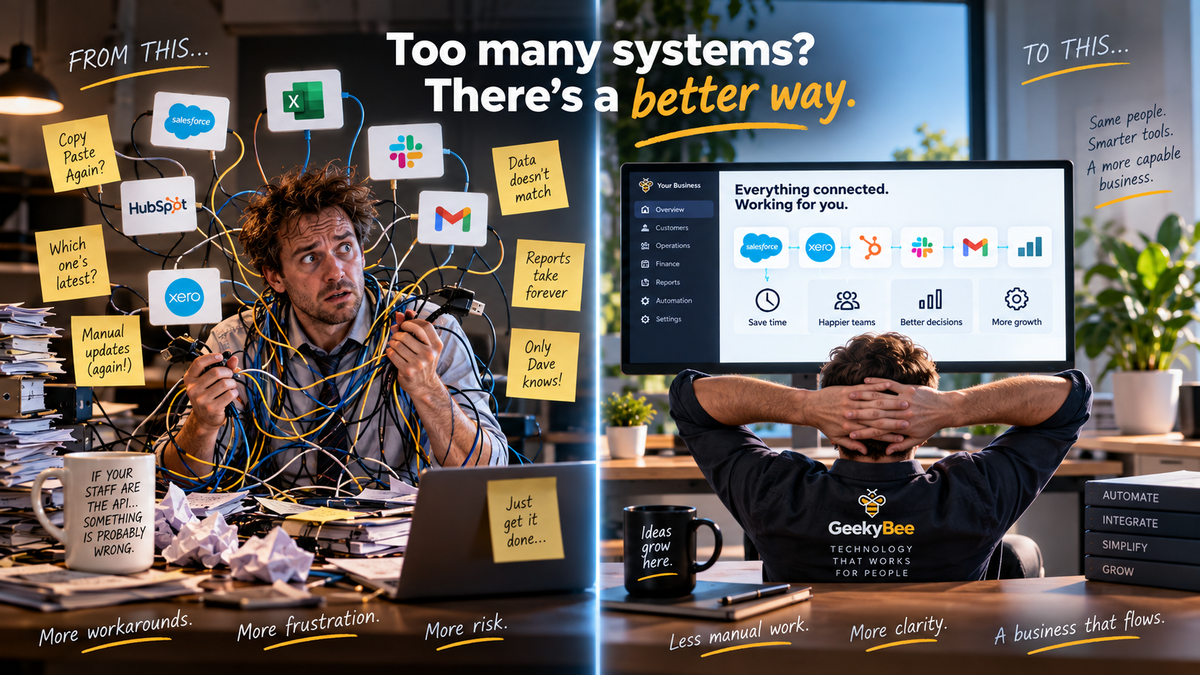
And eventually you have a collection of perfectly reasonable pieces of software, held together by spreadsheets, copy-and-paste, email, and one person called Dave who apparently knows how everything works.
The software hasn't necessarily failed.
The business has simply outgrown it.
That's an important distinction. Software that was absolutely right for a five-person company might be completely wrong once there are 30 people using it. And a process that worked perfectly well for 100 customers can become a nightmare at 10,000.
So how do you know when you've reached that point? Here are seven signs I'd look for.
1. You're Entering the Same Information More Than Once
This is probably my favourite warning sign, because it's so easy to spot.
A customer fills in a form. Someone receives the information by email. They enter it into the CRM. Somebody else puts part of it into the booking system. Accounts enters some of it into another system. And perhaps someone maintains a spreadsheet too, just to be sure everyone knows what's going on.
Five copies of essentially the same information.
Every time a human re-enters data, three things happen: it takes time, it costs money, and there's an opportunity to make a mistake. Change a phone number in one system and it might stay wrong in another. Update an address and suddenly nobody's sure which version is current.
The problem isn't necessarily that any individual piece of software is bad.
The problem is that they aren't talking to each other.
Modern systems with decent APIs should increasingly be capable of moving information between themselves. If your staff have become the API, something is probably wrong.
2. The Spreadsheet Has Quietly Become the Software
I have nothing against spreadsheets. Excel may be one of the most useful pieces of business software ever created.
The danger comes when a spreadsheet quietly stops being a spreadsheet and becomes a business-critical application. You probably know the sort — multiple worksheets, colour-coded cells, formulas nobody wants to touch, macros written by somebody who left three years ago, references to other spreadsheets stored somewhere on the network, and a filename like:
CUSTOMER_MASTER_FINAL_V8_NEW_USE_THIS.xlsx
If deleting a spreadsheet tomorrow would stop the business operating properly, you haven't really got a spreadsheet any more. You've got an application — just one without proper user management, audit trails, validation, workflow controls, backups, or a particularly friendly interface.
Spreadsheets are brilliant for analysis and flexible working. They're much less brilliant as the operational backbone of a growing company.
3. Your Staff Spend Too Much Time Working Around the System
Listen to the language people use.
"You have to do this bit manually." "Don't click that, it doesn't work properly." "Export it to Excel first." "We put 999 in that box because it won't let us leave it blank." "Ignore that screen." "Ask Sarah, she knows how to do it."
These are workarounds. And businesses become remarkably good at normalising them.
A five-minute workaround doesn't sound particularly serious. But if 20 employees perform it six times a day, that's ten hours of staff time every single day — around 2,500 hours a year. Suddenly the five-minute inconvenience isn't very small at all.
One of the most useful exercises a business can run is simply asking staff:
"What stupid thing does the software make you do every day?"
You may get some interesting answers.
4. You've Bought More Software to Compensate for the Software You Already Have
This is another very common evolutionary path.
You start with a CRM. It doesn't handle one particular process very well, so you buy another product. That product doesn't provide the reporting you need, so you add a reporting tool. Then you need something to connect the two. Then marketing needs another platform. Then operations adds something else.
Before long, you've got 12 subscriptions and nobody is entirely sure which system contains the definitive customer record.
None of the individual products may be bad. The problem is the architecture that's emerged around them — what I'd call software sprawl. And it has a cost beyond the subscriptions:
- More user accounts, more passwords, more training
- More integrations and more security considerations
- More data sitting in more places
- More points of failure, and more chances for information to fall out of sync
Sometimes another piece of software is exactly the answer. But there comes a point where adding Product Number 13 probably isn't going to fix the underlying problem.
5. Reporting Requires Detective Work
Here's a question for management:
If I asked for an accurate picture of the business right now, how quickly could you give it to me?
Revenue, customers, pipeline, orders, bookings, performance, operational capacity — whatever metrics actually matter to your company. Can you see them? Or does somebody need to export something from System A, download a report from System B, ask accounts for another figure, update a spreadsheet, remove the duplicates, work out why two numbers don't agree, and produce a report three days later showing what was happening three days ago?
Businesses generate enormous amounts of useful data. But data scattered across six systems isn't necessarily information.
One of the biggest opportunities I see for modern business software — particularly with AI — isn't collecting more data. It's making the information a company already has genuinely useful. Management shouldn't need to run an archaeological excavation every time it wants to understand what's actually happening.
6. Growth Means Adding People to Administration
This one is particularly important.
Imagine your business grows sales by 50%. Fantastic. What happens operationally? Do you need 50% more people processing orders? 50% more people answering routine enquiries, entering information, or producing paperwork?
If administrative headcount has to grow at roughly the same rate as revenue, there's probably an opportunity for technology.
Good software creates operational leverage — it lets the business handle more activity without an equivalent increase in administration. That doesn't necessarily mean replacing people. Quite often it means letting the people you already have concentrate on the work they're actually good at.
A receptionist shouldn't spend half their day copying information between screens. A salesperson shouldn't spend hours updating spreadsheets. A manager shouldn't spend Friday afternoon assembling reports.
People are expensive. More importantly, they're capable of doing things considerably more valuable than data entry.
7. You're Saying No to Things Because the Software Can't Do Them
This is the biggest warning sign of all.
A customer asks for something reasonable. "Unfortunately, our system can't do that." You want to launch a new service — the software can't support it. You want customers to manage something online — the system doesn't expose the functionality. You want to automate a process — there's no API. You want to use AI against your operational data — you can't access it properly.
At this point, software has moved beyond being inconvenient.
It's actively restricting the business.
That's when I'd start taking the situation much more seriously. Technology should enable your business strategy. Your business strategy shouldn't be dictated by the limitations of something somebody bought seven years ago.
The Eighth Sign Hiding Behind All Seven
There's actually another symptom connecting most of these.
Nobody knows exactly how the whole thing works any more. Accounts knows its systems. Sales understands the CRM. Operations has its spreadsheets. Marketing has another collection of platforms. Information passes between them through a combination of integrations, emails, exports and human beings.
The company doesn't really have a system. It has an ecosystem that evolved accidentally.
That's not unusual — it's probably how most business technology environments develop. Very few companies sit down on Day One and design the technology architecture they'll need ten years later. Nor should they. The business changes, the technology changes, the world changes.
The important thing is recognising when what evolved naturally is no longer serving you particularly well.
Does This Mean You Need Bespoke Software?
No. And I think that's an important point.
If you recognise three or four of these symptoms, don't immediately go and commission someone to build a new system. First, understand the problem.
- Sometimes the answer is simply configuring the software you already have properly.
- Sometimes there's an existing product much better suited to the business you are today.
- Sometimes you just need better integration between the platforms you've already got.
- Sometimes automation can remove the manual steps without replacing anything at all.
- Sometimes an AI layer can add functionality to systems you already use.
- And sometimes, yes, bespoke software is the sensible answer.
But "our software isn't working for us any more" and "we need to replace everything" are not the same statement.
Don't Start With the Technology — Start With the Process
If I were looking at this within a business, I'd start with a whiteboard, not a shopping list.
Take one important process — a new customer enquiry, say — and follow it from beginning to end. Where does it arrive? Who deals with it? What system does it enter? Where does the information go next? Who has to do something manually? Where does somebody copy information? Where does the customer wait? Where can things go wrong? Which steps genuinely require a human decision?
You'll often find the real problem becomes fairly obvious. And increasingly, I find myself asking one particular question at every stage:
"Why does a person need to do that?"
Sometimes the answer is: because it requires experience, judgement, empathy, or a genuinely human decision. Excellent — leave the human there.
But sometimes the answer is simply: "Because they've always done it."
That's where things get interesting.
AI Has Moved the Boundary
Until fairly recently, automation worked best when everything was predictable: if X happens, do Y. That remains incredibly useful.
But AI now lets us automate parts of processes that previously required somebody to interpret information — reading an email, understanding what a customer wants, extracting information from a document, categorising an enquiry, summarising a conversation, answering a phone call, assessing information against a set of criteria.
The boundary between "a person has to do this" and "software can do this" has moved considerably. And it's still moving.
For businesses already struggling with ageing systems and manual processes, that's a significant opportunity. You don't necessarily need to recreate your existing process using newer technology. You can ask whether the process itself still makes sense at all.
Your Software Doesn't Have to Be Broken to Be Costing You Money
I think this is the point businesses most often miss.
A system can be completely reliable. It can work exactly as it was designed. Everyone can know how to use it. And it can still be the wrong system for the business you've become.
The question isn't:
"Does our software work?"
Ask instead:
"Does our software let our people and our business work as efficiently as they reasonably could?"
Those are very different questions.
If you're seeing duplicated data entry, spreadsheet dependency, constant workarounds, software sprawl, painful reporting, administration growing in lockstep with revenue, or business opportunities being restricted by your own systems — it's probably time to look at things again.
Not necessarily to replace everything. Not necessarily to build everything. But to understand where the friction actually is.
Because businesses change. Software changes. And sometimes the technology that helped you get where you are isn't the technology that's going to get you where you're going next.
At GeekyBee, that's usually where we start. Not with:
"What software can we sell you?"
But:
"Show me how you currently do it."
The interesting opportunities tend to appear very quickly after that.
Recognise two, three, or all seven signs? Get in touch with GeekyBee — we'll start by mapping how you actually work today, before we ever mention a piece of technology.