
Does AI Need Rightmove? The Next Revolution in Property Search Has Already Started
Rightmove changed how Britain buys property. AI could change it again - and this time the transformation may go much further than simply finding a house online.

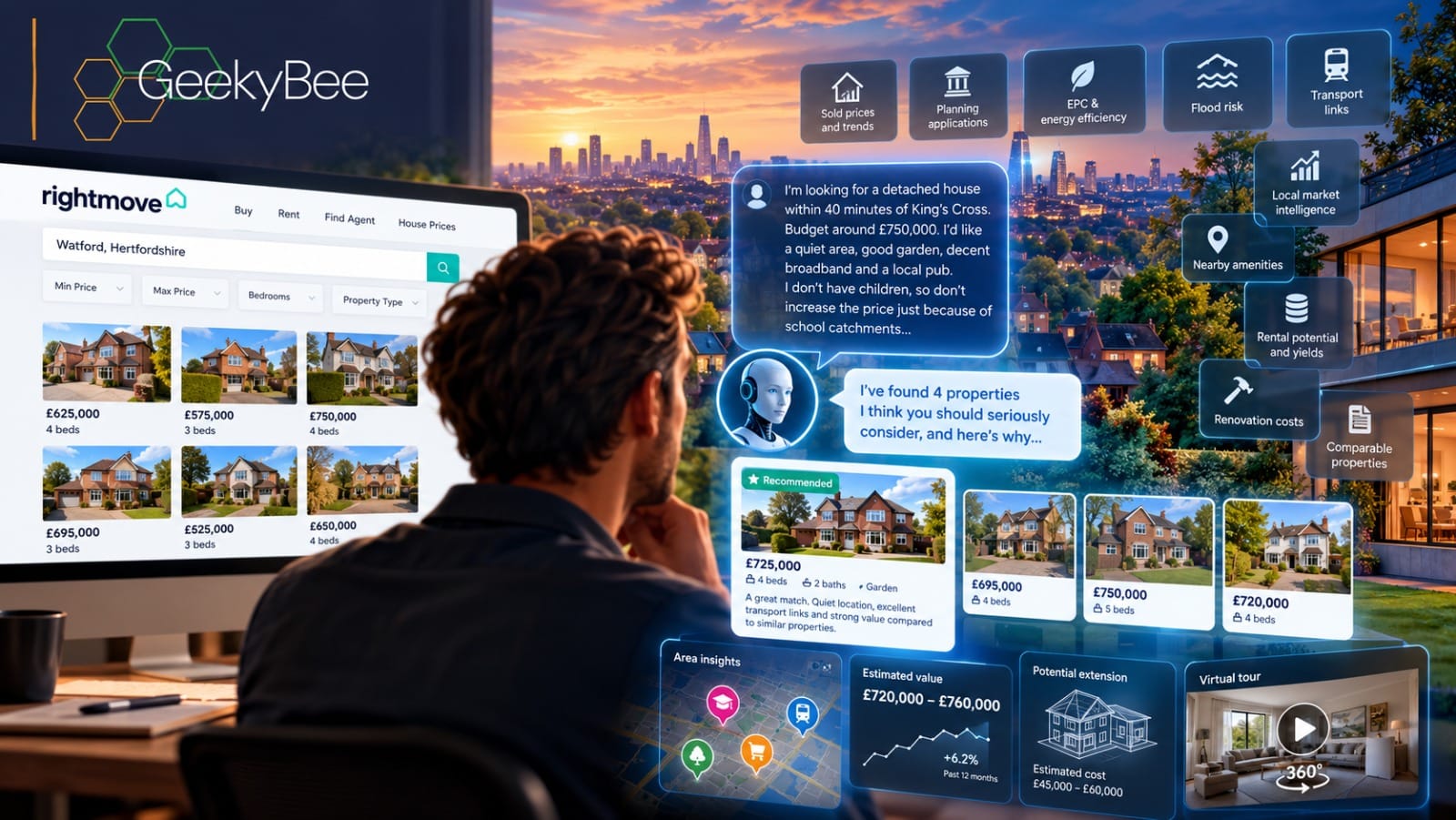
Rightmove changed how Britain buys property. AI could change it again - and this time the transformation may go much further than simply finding a house online.
For more than twenty years, searching for a property in Britain has followed roughly the same process.
You decide where you want to live. You decide roughly what you can afford. You go to Rightmove, Zoopla or another property portal. You enter a postcode, choose the number of bedrooms, set a maximum price and start scrolling.
It was revolutionary when it arrived.
But is it still the best we can do?
That question has suddenly become considerably more interesting.
Rightmove's share price has fallen substantially from its 2025 highs, partly because investors have begun questioning whether AI could eventually weaken - or even replace - the traditional property portal model.
US activist investor Sachem Head has since bought around 6% of Rightmove, reportedly believing that investors have overestimated the threat from AI, and that Rightmove is undervalued.
But not everyone agrees.
Trevor Abrahmsohn, managing director of Glentree Estates and one of the founders of OnTheMarket, takes almost the opposite view. He believes AI represents a genuine threat to traditional property portals because it could fundamentally change how people find, research and ultimately buy property.
Both could be right.
Rightmove can remain an extremely valuable business today while AI gradually changes the way people search for property and the services they expect along the way.
Because the really interesting question isn't whether AI can build a better Rightmove.
It's whether, eventually, AI needs Rightmove at all.
Rightmove's greatest asset isn't actually its data
There is a strong argument in Rightmove's favour:
- Thousands of estate agents provide it with property listings.
- Millions of people use it to search for property.
- Estate agents, therefore, want to advertise there because that's where the buyers are.
It's a tremendously powerful circle and one that has taken Rightmove more than twenty years to build.
But there is an important distinction.
Rightmove doesn't own most of the information that makes its service valuable:
- the properties belong to their owners.
- the listings and photographs come from estate agents and sellers,
- information such as previous sale prices, planning history, EPC ratings, flood risk and local infrastructure is available from other sources and public datasets.
Rightmove's real achievement has been bringing property listings together in one convenient place and attracting such a large audience that estate agents feel they need to be there.
That has created an extremely successful business.
But what happens if technology no longer needs all that information to be in one place?
AI is particularly good at finding, combining and making sense of information from different sources.
And that's where the traditional property portal model starts to become much more interesting
We may not need another giant property database
One argument against AI disrupting Rightmove is straightforward: An AI property search needs properties to search.
Absolutely. But that doesn't necessarily mean those properties have to live inside one central portal.
A new AI-powered service called MyPorta provides an interesting early example. It claims to index more than 860,000 available UK properties by finding listings on publicly accessible estate and letting agents' websites. It then identifies the relevant agent and can direct interested buyers back to them. Agents can also upload properties or provide their listings directly.
The number of properties is MyPorta's own claim, but it's the way the system works that's particularly interesting.
Traditional property portals bring thousands of listings into one place and then give us filters to search through them.
AI potentially changes that.
Instead of requiring everything to be stored in one place, AI is increasingly capable of finding information from different sources, bringing it together and understanding what it means.
That changes the proposition from: "Come to us because all the properties are here."
to: "Tell me what you're looking for. I'll find it wherever it is."
That's a fundamentally different way of searching for property.
Property search is about more than bedrooms and postcodes
Think about how people actually describe the home they're looking for.
Very few people naturally think: "Three bedrooms, £700,000 maximum, within three miles of WD17."
They're much more likely to say: "I'd like somewhere reasonably quiet but I don't want to be in the middle of nowhere. I need to get into London a couple of days a week. I'd like a decent-sized garden. I don't mind doing some work, but I don't want something that needs completely rebuilding. A good pub within walking distance would be nice. I'd rather have a bigger house outside the obvious area than pay a premium just for the postcode."
That's a conversation. And conversations are something AI has become remarkably good at understanding.
Now imagine an AI property system taking that description and searching hundreds, or potentially thousands, of available properties.
But it could go much further than simply finding houses that match.
It could also:
- compare the asking price with previous sales and similar properties nearby;
- check the EPC, planning history and flood risk;
- consider transport links and the surrounding area;
- examine photographs and floorplans;
- calculate the price per square foot;
- identify whether there may be potential to extend;
- find similar properties that have recently sold; and
- potentially estimate the cost of work or renovations.
Instead of returning 327 search results, and leaving you to work through them yourself, it might say: "I've found 14 possibilities. These are the four I think you should seriously consider, and here's why."
At that point we haven't built a better search box – we’ve started building a property adviser.
This is where systems such as GeekyBee’s PropScope become interesting
This idea of moving from simply finding a property to actually understanding it is one of the reasons we've been developing PropScope.
PropScope isn't intended to be another website displaying thousands of property listings. We already have plenty of those.
The more interesting challenge is understanding whether a particular property actually makes sense.
A property is surrounded by information: previous sale prices, comparable properties, planning decisions, energy performance, environmental risks, local development, rental potential, market trends and dozens of other factors.
- Historically, finding all of that information could mean using several different systems and spending a considerable amount of time researching it.
- AI allows us to bring much of that information together, analyse it and start asking more useful questions.
Instead of simply asking: "Does this house have three bedrooms?"
we can start asking: "Does this property make sense for me?"
And the answer will depend entirely on who's asking.
- For an investor, that might mean looking at purchase price, comparable sales, rental demand, potential yield, development opportunities and risk.
- For a homebuyer, it might mean affordability, commuting, running costs, local amenities, planning history and whether the asking price looks reasonable compared with similar homes.
- For an estate agent, it could mean having much of the information needed for a valuation already researched and brought together before they even visit the property.
The property hasn’t changed.
What changes is our ability to understand it from the perspective of the person looking at it.
And that’s where AI starts becoming far more useful than simply giving us another way to search for houses.

Find out more about PropScope, GeekyBee's UK property intelligence platform.
And why should the journey start with an estate agent?
This is where things become more disruptive.
Imagine you’re considering selling your home. Instead of immediately inviting three estate agents around to provide valuations, you could simply ask an AI property system: “What do you think my house is worth?”
The AI could examine recent comparable sales, current listings, previous transactions, the characteristics of your property and what’s happening in the local market. It won’t necessarily produce a perfect valuation – but then three estate agents won’t necessarily give you the same valuation either.
It might come back with: “Based on comparable properties and recent sales, I’d estimate your home is currently worth between £610,000 and £635,000. At around £625,000, these are the properties nearby you’d be competing against."
But valuation is only the beginning.
You could then ask, "What would I need to do to sell it?"
- The AI could guide you through photographing the property and gathering the information needed to advertise it.
- A modern smartphone could help measure rooms and even capture enough spatial information to help create a floorplan.
- AI could draft the description, organise the photographs, assemble the property details and prepare much of the information a prospective buyer would want to see.
None of this necessarily removes the estate agent from the process. It removes much of the work that currently has to happen before the estate agent can add real value.
Add 360° photography, video and virtual reality, and things become even more interesting.
- A prospective buyer could walk through a detailed virtual version of the property before deciding whether it's worth travelling to see it in person. They could ask questions as they move around, examine individual rooms and get a much better idea of whether the property suits them.
AI doesn't necessarily remove the estate agent.
It changes where the estate agent becomes valuable.
AI could make estate agents more productive
If AI can do more of the early work, the estate agent doesn't disappear. Their time simply gets used differently.
Today, an agent may spend a considerable amount of time dealing with people who are only casually interested in a property. They answer questions, send details, arrange appointments and conduct viewings - often before knowing whether the buyer is genuinely interested or can afford the property.
AI could move much of that work to the beginning of the journey.
- a buyer could use AI to find a property, compare it with similar homes and research the surrounding area.
- they could ask questions about the property, look at previous sale prices and understand how the asking price compares with the local market.
- they could then take a 360° or VR tour and explore the property in much more detail than photographs alone allow and decide whether the property is genuinely worth seeing in person.
By the time they request a physical viewing, they could already know that the property suits their requirements, fits their budget and is worth seeing in person.
That's a very different type of viewing.
Instead of showing ten properties to people who are simply looking around, an agent might show three or four properties to buyers who have already done much of their research and are genuinely interested.
The same applies on the seller’s side. AI can help prepare information, answer routine questions and identify serious enquiries before they reach the agent.
That potentially allows an estate agent to manage far more properties without negatively impacting their service. In fact, the service could improve because the agent has more time to spend where their experience actually matters.
Understanding people. Giving advice. Negotiating. Solving problems. And getting the sale completed.
This is an important distinction when we talk about AI replacing jobs.
In estate agency, AI may not replace the estate agent at all. It could remove much of the work surrounding them and allow them to concentrate on the parts of the job that genuinely require a person.
Abrahmsohn makes a similar distinction. While AI can increasingly handle many operational parts of estate agency, human judgement, relationships and negotiation are considerably harder to replace.
AI could therefore make estate agents more valuable, while making some of the systems they currently depend upon less valuable.
And that brings us back to Rightmove.
Rightmove knows something is changing
It would be unfair to suggest that Rightmove is simply standing still and watching all of this happen.
It isn't.
Rightmove is already investing heavily in AI. It has introduced conversational property search through Ask Rightmove and is developing other AI-powered services for both consumers and the property industry.
That tells us something important.
The future isn't necessarily about somebody building an AI platform that suddenly replaces Rightmove. Rightmove itself could change.
The Rightmove of 2035 could be a very different business from the property portal we know today, offering much more than a searchable collection of property listings.
The uncertainty is whether Rightmove can make that transition successfully - and investors are already trying to work that out.
Sachem Head's reported position is that investors have become too worried about the threat from AI and have therefore pushed Rightmove's share price too low. It has bought around 6% of the company and has also reportedly encouraged Rightmove to return more money to shareholders through share buybacks.
Rightmove is already buying back its own shares under a programme announced in July 2026.
None of this means AI will destroy Rightmove. Equally, it doesn't mean Rightmove's position is guaranteed forever
What it shows is that the property market is changing quickly enough for investors, estate agents and Rightmove itself to be asking what a property portal needs to become in an AI-driven world.
And perhaps that's the more interesting question.
Does AI replace Rightmove - or does Rightmove eventually become something that looks much more like the AI property platforms now beginning to emerge?
But there's an even bigger possibility
What happens when a property doesn't even have to be officially for sale before AI can match it with a potential buyer?
Imagine telling your property AI: "I'm not particularly looking to move, but if someone offered me £700,000 I'd probably consider it."
Somewhere else a buyer tells their AI: "I can't find what I want. I'd pay up to £725,000 for the right four-bedroom house in these six roads."
Today, those two people may never find each other.
The homeowner hasn't put their property on the market, so the buyer doesn't know it's potentially available. And because the property isn't advertised, it won't appear in a Rightmove search.
But an intelligent property network could potentially make that connection:
- the seller wouldn't necessarily need to advertise their home publicly.
- the buyer wouldn't necessarily need to search through hundreds of listings
- the system could simply recognise that what one person wants matches what the other might be willing to sell.
At that point, we're moving beyond the idea of a traditional property portal.
We're starting to create an intelligent property marketplace that connects buyers and sellers based on what they actually want.
And that could ultimately present a much bigger challenge to the traditional portal model than simply building a better way to search its listings.
From finding property to understanding property
Rightmove changed the British property market by bringing thousands of estate agents' listings together in one place. For buyers, it made finding and comparing properties dramatically easier.
But the technology available to us has moved on.
The next step isn't simply adding AI to the existing property portal. It's using AI to change what happens before, during and after the property search.
Instead of simply finding a house, AI can help a buyer understand it: Is the asking price reasonable? What have similar properties sold for? What's happening to prices in the area? Are there planning issues? What are the likely running costs? Could the property be extended? How does it compare with the other properties being considered?
Add automated valuations, 360° and virtual viewings, intelligent property matching and better financial information, and AI starts helping with much more of the decision - not just the initial search.
This is where the next generation of property technology, including systems such as PropScope, becomes particularly interesting.
The aim isn't to give people another website containing thousands of properties. We already have those.
The aim is to take all the information surrounding a property and turn it into something useful and understandable that could benefit buyers, sellers, investors and estate agents alike.
Buyers make better-informed decisions, sellers understand their property and local market, investors can identify opportunities more quickly, and estate agents spend less time gathering information that technology can increasingly provide for them.
Rightmove's great achievement was making it easier to find property.
The next generation of property technology is about making it easier to understand property, decide whether it's right for you, and work out what to do next.
That's where AI could bring about the much bigger change.