How Much Does Bespoke Software Development Cost in the UK?
Nobody arrives with a finished blueprint — and that's exactly the point. We round off the rough idea, build what fixes the real problem, then grow it through years of "what if's" and "if only's." Cheaper, faster ROI, and it's why clients still call us back after 10 years.

A realistic pricing guide — with the numbers most agencies won't give you upfront
So far in this series, I've looked at what bespoke software actually is, and whether a business should buy an existing product, build its own, or combine the two.
Which inevitably brings us to the question everyone actually wants answered:
How much is this going to cost me?
The traditional software industry answer is:
"It depends."
Which is completely accurate and completely useless. So let's put some numbers around it.
The Short Answer
In the UK, bespoke business software could realistically cost anything from a few thousand pounds for a focused application or integration, to hundreds of thousands for a large enterprise platform.
That's an enormous range. But asking "how much does bespoke software cost?" is a little like asking:
"How much does a building cost?"
A garden office and a 200-bedroom hotel are both buildings. They clearly don't cost the same amount. Software is much the same.
A system that pulls information from a form, applies some business rules and updates your CRM is fundamentally different from a multi-tenant SaaS platform handling thousands of users, payments, complex permissions and dozens of integrations.
So rather than pretending there's a standard price, let's look at what you're actually paying for.
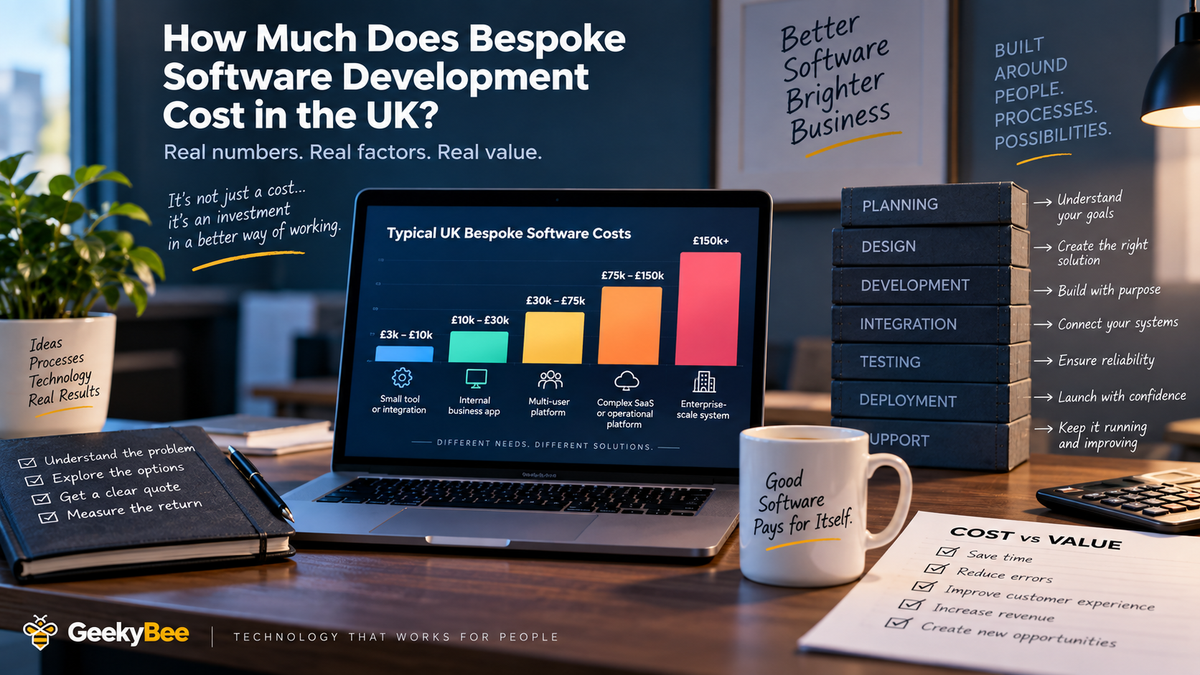
Realistic UK Bespoke Software Costs (Ballpark Figures)
As a broad planning guide, I'd think about bespoke software development costs in roughly these terms:
| Type of Project | Indicative Budget |
|---|---|
| Small automation / integration / focused tool | £3,000–£10,000 |
| Bespoke internal business application | £10,000–£30,000 |
| Larger multi-user business platform | £30,000–£75,000 |
| Complex SaaS / operational platform | £75,000–£150,000+ |
| Enterprise-scale system | £150,000–£500,000+ |
These aren't quotes — they're useful ballpark figures. You'll find UK developers and agencies quoting above and below every one of them.
The more interesting question is: why?
What Are You Actually Paying For?
People naturally assume software cost is determined by the number of screens. It isn't. A system with six screens can be considerably more complicated than one with 30. The expensive bit is generally what happens behind them.
Consider a simple-looking button labelled "Book Appointment."
What happens when somebody presses it? Does the system need to:
- Check live availability
- Identify the customer, or create a new one if they don't exist
- Check which service they require and calculate duration
- Take a deposit and process a card payment
- Send confirmation
- Update another system
- Trigger reminders
- Handle cancellation rules
- Record everything for auditing
One button. Potentially hundreds of decisions and operations behind it. That's where software complexity actually lives.
The Biggest Cost Driver Is Complexity — Not Size
A relatively small internal application used by ten people might require integration with three legacy systems, complicated permissions and unusual business rules. That can be harder to develop than a customer-facing application used by thousands of people doing something relatively straightforward.
Things that tend to increase development costs include:
- Multiple types of users and permissions
- Complicated business rules
- Third-party integrations
- Legacy systems
- Payment processing
- Mobile applications
- Real-time information
- Large data migrations
- Complex reporting
- AI functionality
- Regulatory or compliance requirements
- High availability requirements
- Significant numbers of simultaneous users
None of those automatically makes a project expensive. But every additional dependency adds something that needs designing, developing and testing.
Integrations Can Be Wonderfully Easy — Or Surprisingly Horrible
Modern software increasingly talks to other software through APIs. When those APIs are good, life is lovely — we can authenticate, request information, send information and get predictable responses.
Unfortunately, not every API is lovely. Sometimes the documentation is incomplete. Sometimes the system only exposes half the information we need. Sometimes there are usage limits. Sometimes there isn't an API at all.
So when someone says:
"It just needs to connect to our existing system."
The word just deserves investigation. Integration work can range from a few hours to a substantial development project in its own right.
Design Costs Money Too
There's a significant difference between an internal tool and a commercial application.
If five trained employees are using a system internally, it can be relatively utilitarian — clear, efficient and reliable. If you're launching software to thousands of paying customers, expectations are rather different.
Now you need to think much more deeply about user experience, onboarding, accessibility, responsive design, mobile behaviour, branding, error handling, help documentation, different devices and browsers — and people doing things you never imagined they'd do.
A polished consumer-facing product will generally require more design and testing than an internal operational tool.
Then There's the Bit Nobody Sees
Some of the most important parts of software are almost invisible to the customer: authentication, encryption, backups, databases, logging, monitoring, permissions, security, error handling, recovery, deployment, testing.
None of them makes for an exciting screenshot. But they're often the difference between a prototype and a production system you can actually trust with your business.
It's relatively easy to make software appear to work. Making it keep working reliably once real people start using it is another matter entirely.
Why Do Two Developers Give Completely Different Quotes?
This causes enormous confusion. You describe the same project to two companies. One quotes £20,000. The other quotes £70,000. Has somebody lost their mind?
Not necessarily. They may simply be quoting completely different approaches.
One might use a small senior development team. Another might allocate a project manager, business analyst, UX designer, frontend developer, backend developer, QA engineer, DevOps engineer, technical architect and account manager — you've effectively employed a small technology department before anybody writes a line of code.
For the right project, that's entirely justified. For a 20-person company wanting to automate an internal workflow, it may be overkill.
Large agencies have significant overheads. Small consultancies have fewer. Freelancers have fewer again. Offshore teams can dramatically reduce development rates but may require considerably more project management from the customer.
There isn't automatically a right or wrong answer — you need an approach proportionate to the project.
AI Is Changing How Software Development Costs Work
This is where things get particularly interesting. AI isn't only changing the software we can build — it's changing how we build software.
Modern AI-assisted development tools help with generating code, creating tests, debugging, documentation, refactoring, database design, building interfaces, understanding unfamiliar code, producing repetitive components and rapidly prototyping ideas.
I use AI extensively within my own development process — not because I want AI making architectural decisions (I don't), but because after nearly 40 years in IT, I know the difference between letting a machine make decisions and using an extraordinarily capable tool to accelerate work I already understand. That distinction matters.
AI Should Make Bespoke Development Cheaper
I think this is something the software industry is going to have to confront. If a development company can now produce certain types of software significantly faster because of AI-assisted development, should the customer still be charged as though everything were being written manually?
I don't think so.
The value of experience hasn't disappeared — if anything, it's become more important. Someone still needs to understand the business, design the architecture, spot bad assumptions, understand security, choose the right technology, recognise when AI-generated code is wrong, and ultimately take responsibility for the finished system.
But AI can remove a substantial amount of repetitive development work. Projects that historically required a large team can increasingly be delivered by smaller, experienced teams using AI effectively. For SMEs in particular, I think this changes the economics of bespoke software considerably.
Nobody Arrives With a Finished Blueprint — And That's Fine
Here's something worth saying plainly, because it changes how a lot of these budgets actually get spent.
Most companies do not come to us with a fully blown, intricately planned software design. Almost nobody does. What they usually have is an idea — sometimes a very good one — with the edges still rough. Our job is to round that idea off into something that actually works.
That's not a gap in the process. It's most of the value.
Because after 40 years of fixing stuff, you learn where one road leads to three months of pain and where another road quietly avoids it. You've seen the version of this system before — in a different industry, for a different client, with a different name — and you know which decisions come back to bite people eighteen months later. A client can't be expected to know that. We're not meeting a business owner to test their software architecture skills. We're meeting them to think about the things they haven't thought of yet.
So we ask questions, they give us answers, and between us we design a piece of software.
That's when the fun really starts.
Because once something is actually built and being used, a different kind of conversation begins — the "what if's" and the "if only's."
What if it could automatically produce the invoice? If only it could read the incoming emails and work out who should actually deal with them?
Every one of those questions grows the system a little further, into curing the next problem along. That's how we write software for ourselves. It's how we write it for you too.
If we tried to do it the other way round — sitting in a room trying to anticipate every feature you could conceivably ever want before a single line of code was written — we'd blow your entire budget imagining things you'll almost certainly never use.
So instead, we build a working system that fixes this problem, or these problems. And we let that be the kick-off point, not the finish line.
It's the end of the beginning, not the end.
This approach isn't just gentler on the nerves. It keeps the costs down, and it makes the return on investment come back faster — because you're not waiting three years to find out whether the whole thing works. Development becomes ongoing rather than a single terrifying event, and because each change is small, its value to the business can be calculated and realised almost immediately. You know within a fortnight whether the automatic invoicing feature actually saved anyone any time. You don't need a steering committee and a six-month review cycle to find out.
Compare that with the £100,000 piece of software that takes three years of R&D and arrives doing 20% of things nobody will ever actually use. That's a genuinely difficult project to justify — not because the technology is wrong, but because nobody gets to find out if it works until it's finished, by which point the budget, the market and quite possibly the person who commissioned it have all moved on.
Build for real processes, to fix real problems, and the system is usable in a basic form very quickly. Users aren't sitting through training on a hundred functions on day one. They're learning it the way you'd learn any tool that's actually part of your working week — a "what's new this week" fashion, a feature at a time, each one solving something they were just complaining about.
It's also why some of these relationships last. We have clients we've been working with for ten years who are still coming back asking for updates — to handle a new type of project, a new client requirement, or, increasingly at the moment, to have AI built properly into a system that's already been quietly doing its job for years.
Don't Pay to Build Version 10 on Day One
This is probably the easiest way to control development cost: don't build everything.
I've seen software specifications listing dozens of features before a single customer has ever used the product. Half of them will probably turn out to be unnecessary.
Start with the problem. What's the smallest version of the system that genuinely solves it? Build that. Use it. See what happens. Real users will very quickly tell you which assumptions were correct — and which weren't.
I'd rather spend £15,000 proving something works and invest another £15,000 improving it than spend £50,000 building everything we imagined we might need. That's not cutting corners. That's reducing risk.
MVP Doesn't Mean Rubbish
MVP — Minimum Viable Product — is a term that's become horribly abused. "Minimum" doesn't mean badly designed, insecure or half-working. It means:
The smallest complete version capable of proving the idea.
If we're building an internal system, perhaps Version 1 handles the single workflow causing the biggest administrative headache. If we're building a commercial SaaS platform, perhaps it contains just the core feature customers will actually pay for. Everything else can follow.
The objective isn't to build less software forever. It's to avoid spending money building the wrong software.
What About Ongoing Costs?
Software doesn't become free the moment development finishes. There will normally be some combination of hosting, database services, backups, email or SMS services, third-party APIs, AI usage, monitoring, domain names, security maintenance, software updates, support and further development.
For many SME applications, the underlying cloud infrastructure can be surprisingly inexpensive. But usage matters — an application used by 20 employees has very different infrastructure requirements from a SaaS platform serving 100,000 customers. AI introduces another variable, since many AI services charge according to usage.
The good news is that these costs can generally be measured and designed into the business model from the start.
Maintenance Is Different From Development
This distinction is worth making. There are really three types of expenditure after launch:
- Infrastructure keeps the software online.
- Maintenance keeps it secure and compatible.
- Development makes it do new things.
They aren't the same. If someone asks for a completely new module six months after launch, that's not maintenance. Equally, you shouldn't need to commission a development project every time a security dependency needs updating. Make sure any proposal clearly explains what happens after launch.
Fixed Price, Hourly, or Phased?
Both fixed pricing and hourly/day-rate development can work. Fixed pricing gives you certainty, but requires reasonably clear requirements upfront. Hourly gives greater flexibility, but transfers more cost risk to you.
There's a third approach I increasingly prefer: build in defined phases. Agree what we're solving. Define the first phase. Set a budget. Deliver it. Review what we've learned. Then decide what happens next.
That gives the business financial control without pretending we know everything about a system before we've started building it.
The Most Expensive Words in Software Development
While we're talking about budgets, there's one phrase capable of making almost any developer slightly nervous:
"While you're in there..."
While you're in there, could it also send invoices? Could customers have their own login? Could we make an app? Could we add AI?
Yes. Probably. But that's called scope.
Projects rarely become expensive because somebody suddenly doubles the price of writing code. They become expensive because the thing being built gradually becomes much bigger than the thing originally discussed.
Good project management doesn't prevent ideas. It simply separates what we're building now from what we might build next.
The Cheapest Quote Can Become the Most Expensive
I've been in technology long enough to be suspicious of extraordinarily cheap solutions. That doesn't mean expensive automatically equals good — far from it. But if three credible developers think something requires three months, and somebody on the internet says they'll do it for £800 by Friday, I'd ask a few questions:
- Who owns the source code?
- Where is it hosted, and how is it secured?
- Is there documentation another developer could work from?
- What happens if the developer disappears?
- Are commercial licences being used correctly?
- How are backups handled, and how has it been tested?
Cheap software becomes extremely expensive when you have to throw it away and start again.
But the Most Expensive Quote Isn't Automatically the Best Either
A £100,000 solution isn't automatically ten times better than a £10,000 one. You may simply be buying a different organisation — more meetings, more project management, more documentation, more layers between you and the developer.
Sometimes that's exactly what a large organisation needs. Sometimes it isn't. For an SME, direct access to experienced people who understand both the technology and the business can often be considerably more valuable.
The goal isn't to find the cheapest developer, or the most expensive. It's to find the right delivery model for the problem.
How Do You Know Whether the Investment Makes Sense?
Go back to the business case.
Suppose a bespoke system costs £20,000, and it saves 40 staff hours every week. Even at a conservative fully loaded employment cost of £25 an hour, that's:
40 × £25 = £1,000 per week — roughly £52,000 per year.
Ignoring other costs for a moment, the development investment has potentially paid for itself in under five months.
Now consider a different £20,000 system that saves one employee an hour a month. Probably not such an exciting investment.
That's why software shouldn't be evaluated purely on development cost. It should be evaluated on return.
And Return Isn't Always Staff Savings
ROI can come from several places: reduced administration, fewer errors, more transactions, faster customer response, better conversion rates, reduced subscription costs, improved customer retention, 24/7 availability, better management information, faster decision-making, or the ability to handle more business without employing proportionally more people.
Sometimes the strongest argument for bespoke software isn't that it saves money. It's that it lets the business do something it couldn't previously do at all.
So What Should You Actually Budget?
If you're an SME looking at bespoke software for the first time, I wouldn't start by setting an arbitrary £50,000 technology budget.
I'd start smaller. Identify a valuable problem. Understand what it's costing you. Define what success would look like. Then find out what the smallest sensible solution costs.
It might be £5,000. It might be £25,000. It might genuinely require £100,000. And sometimes the answer will be:
Don't build it. Buy something that already exists.
That's a perfectly successful outcome from a technology conversation.
The Question Isn't Really "How Much Will It Cost?"
It's: "What will we get back?"
That's the part of software development pricing I think businesses should concentrate on. If spending £20,000 saves £100,000 over three years, the interesting number isn't £20,000. If spending £5,000 solves a £500 problem, it's still too expensive.
Bespoke software should be treated like any other business investment: understand the problem, understand the cost, understand the risk, understand the return — and build accordingly.
At GeekyBee, that's the conversation I'd rather have before we talk about frameworks, databases, APIs or AI. Because ultimately, nobody actually needs bespoke software.
They need a business problem solved. The software is simply how we get there.
Working out what a bespoke solution might actually cost for your business? Get in touch with GeekyBee — we'll start with the problem and the numbers, not a sales pitch.