Off-the-Shelf vs Bespoke Software: Which Is Right for Your Business?
Off-the-shelf or bespoke? Most businesses treat it as either/or. It isn't. Score what the software actually does against what matters, calculate the real five-year cost, then ask the one question that changes everything: buy, build, or both?

A practical decision framework — not another theoretical comparison
You've identified a problem in the business and decided software could probably solve it.
Now comes the harder question.
Do you buy something that already exists, have something built specifically for you, or combine the two?
My starting position is fairly simple:
Don't build software you can sensibly buy.
There are thousands of very good software products out there, and recreating something that already solves your problem isn't innovative — it's expensive.
But the word sensibly matters.
Because there's a considerable difference between software that technically does the job and software that genuinely works for the business.
So rather than another theoretical comparison of bespoke versus off-the-shelf software, let's look at how I'd actually make the decision.
First Question: How Much of Your Requirement Already Exists?
Let's imagine you've identified an existing platform that appears to meet your needs.
Ignore the sales demonstration for a moment. Write down the ten things the system absolutely must do. Not things that would be nice — the ten things that actually matter.
Then score the product.
- If it comfortably handles 9 out of 10, and the tenth isn't critical, I'd probably buy it.
- If it handles 7, and the remaining three can easily be integrated or automated, I'd look at a hybrid approach.
- If it handles 4, and the salesperson spends most of the demo explaining workarounds, I'd be considerably less enthusiastic.
That's the first test:
How much compromise are you buying along with the software?
The 80% Problem
This is where many software purchases go wrong.
A product does 80% of what the business needs. That sounds pretty good. The problem is that the missing 20% might represent 60% of the operational headache.
Perhaps the software manages customer records beautifully but can't accommodate your booking process. Perhaps it handles orders but won't talk to the system your operations team relies on. Perhaps the reporting is excellent — except for the one report management actually needs.
Don't measure software purely by the number of features it provides. Measure it by the importance of the problems it solves.
Not all requirements have equal value.
What Will It Really Cost Over Five Years?
Subscription pricing makes software look wonderfully inexpensive. £99 a month doesn't sound like much. But software decisions tend to last for years, so calculate the actual cost.
Take:
Monthly subscription × users × 60 months
Then add:
- Setup and implementation
- Training
- Additional modules
- API access
- Increased storage
- Premium support
- Consultancy
- Integration tools
- Price increases
- Other software required to fill the missing functionality
A £50-per-user platform used by 30 people is £90,000 over five years — before you've added anything else.
That doesn't automatically mean bespoke software would be cheaper. But now we're comparing sensible numbers.
I'd do exactly the same calculation for bespoke development: initial development, hosting, maintenance, updates, security, further development, support. Then compare the total cost of ownership, not the advertised monthly price.
Now Put Staff Time Into the Calculation
This is the number that regularly gets forgotten.
Suppose the off-the-shelf option requires an extra 30 minutes of admin per employee, per day. For 20 employees, that's ten hours a day — roughly 2,500 hours a year. Over five years, that's 12,500 hours. Even at a modest employment cost, the "cheaper" software suddenly becomes very expensive indeed.
The reverse is also true. If the off-the-shelf system works perfectly well, spending £50,000 building something custom to save someone ten minutes a week would be ridiculous.
Which is why I don't much like blanket statements like:
"Bespoke software is expensive."
Compared with what? That's the calculation that actually matters.
How Important Is This Process to the Business?
Here's another useful test.
Imagine two systems. One manages staff holiday requests. The other controls how you deliver your core service to customers.
I'd be much more inclined to use standard software for the first. The second deserves considerably more thought.
Why? Because the closer software gets to the thing that makes your business valuable, the more important flexibility becomes. If your competitive advantage comes from doing something faster, differently or better than competitors, forcing that process into exactly the same software they're using may not make sense.
So ask:
Is this software supporting the business, or is it part of what makes the business different?
That distinction matters.
How Much Control Do You Need?
With commercial software, you're effectively renting somebody else's product. That's perfectly fine — but it has consequences.
They decide what gets developed. What gets removed. What the product costs. When the interface changes. And occasionally, they decide that the product you've built half your business around is being discontinued.
I've been in IT long enough to see plenty of supposedly permanent technologies disappear.
With bespoke software, you have considerably more control. You determine the roadmap, decide which integrations matter, and control when changes happen. But you also inherit responsibility for maintaining it.
Control isn't free. The question is whether control is valuable enough to your business to justify owning that responsibility.
How Quickly Do You Need It?
This one strongly favours off-the-shelf software.
If you need a CRM next week, buy a CRM. If you need accounting software tomorrow, buy accounting software. Established products deploy quickly because most of the work has already been done.
Bespoke development takes longer — requirements have to be understood, interfaces designed, systems developed, integrations built, testing completed.
One warning, though:
Don't confuse quick to install with quick to implement.
I've seen businesses buy enormous platforms remarkably quickly, then spend months trying to configure them. A login screen appearing doesn't mean the system has actually become part of the business.
What Happens if You Double in Size?
This is where I'd start looking beyond today's requirement.
Suppose you have 15 employees today. What happens at 30? Or 100? Does the pricing still work? Does the workflow still work? Does the software support multiple offices, brands or business units? Will manual admin increase proportionally with growth?
One of the worst outcomes is implementing a system successfully, then discovering that growth makes it increasingly painful.
You don't need software built for a multinational corporation if you're a ten-person business — but you do need to know where the ceiling is.
How Unusual Is Your Workflow, Really?
Every company believes it's unique. Most aren't — at least, not completely.
Businesses send invoices, manage customers, book appointments, run payroll, store documents, send marketing emails. There's generally little reason to reinvent any of that.
But businesses often do have particular processes that genuinely are unusual — how you assess opportunities, price work, move information between departments, or serve customers. How decisions get made. How your industry actually operates.
Those are the areas where bespoke development becomes genuinely interesting, which leads to a principle I've grown increasingly fond of:
Standardise the ordinary. Customise the important.
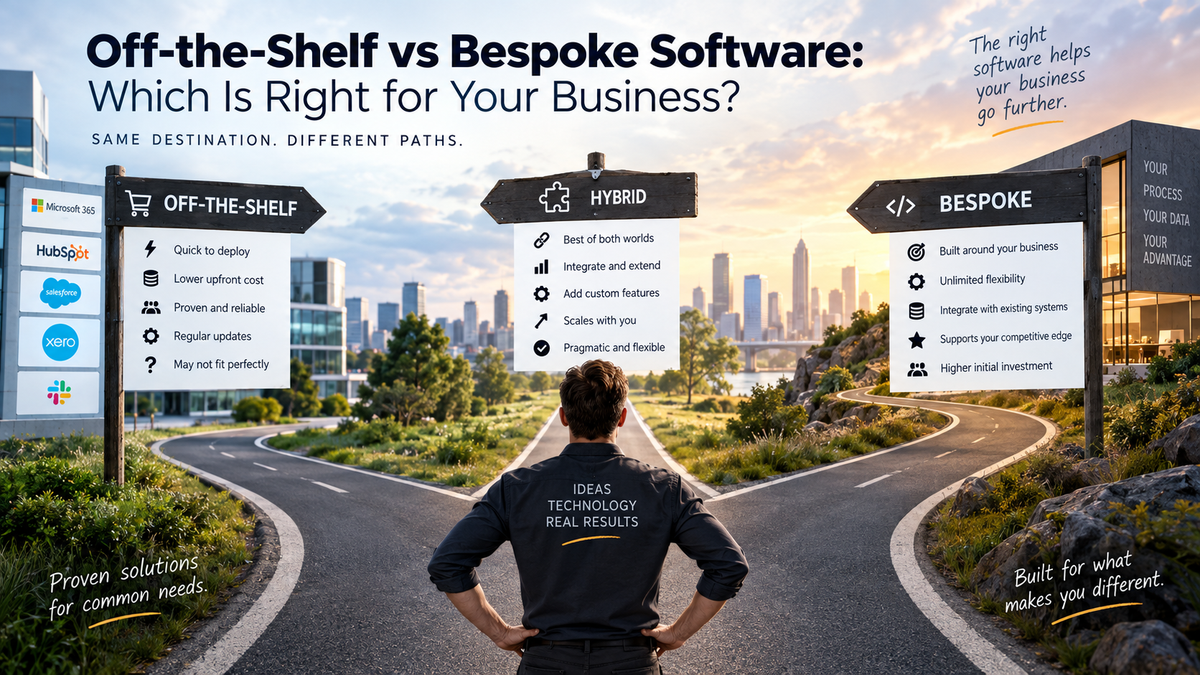
The Three Options — Not Two
This is where I'd slightly challenge the title of this article, because in reality, businesses usually have three options.
Option 1: Buy. Use an established product. Best when your requirement is common, the product fits well, and there's little competitive value in building your own version.
Option 2: Build. Develop software around the business. Best when the process is important, unusual, commercially valuable, or poorly served by existing products.
Option 3: Buy + Build. Use established software for standard functionality, and develop the missing pieces around it.
Increasingly, this is the option I find most interesting. You might use an established accounting system, CRM or booking platform, while building your own customer portal, AI layer, automation, reporting or operational workflow on top. You get the reliability of established products without forcing the whole business into their limitations.
AI Makes the Hybrid Option Much More Powerful
AI has made this third option particularly compelling.
We can now build intelligent layers around existing business systems.
A company doesn't necessarily need an entirely new CRM — it might need AI that interprets incoming enquiries and updates the CRM automatically. It might not need a new booking platform — it might need a voice agent that talks to customers and interacts with the booking platform already in place. It might not need a new database — it might need a better way of analysing the information already sitting across several databases.
This is where I think a lot of business software development is heading. Not replacing everything.
Connecting, augmenting and improving what's already there.
A Simple Buy-vs-Build Decision Scorecard
If I were evaluating a software decision with a client, these are roughly the questions I'd put on the table:
| Question | Buy | Build |
|---|---|---|
| Is the requirement common across most businesses? | ✓ | |
| Does an existing product meet nearly all critical requirements? | ✓ | |
| Do you need something operational quickly? | ✓ | |
| Is the process central to your competitive advantage? | ✓ | |
| Is your workflow genuinely unusual? | ✓ | |
| Are workarounds consuming significant staff time? | ✓ | |
| Do you need complete control over future development? | ✓ | |
| Is per-user pricing becoming expensive at scale? | ✓ | |
| Could existing software work with some custom integration? | Consider Hybrid | Consider Hybrid |
It isn't a mathematical formula. But it usually makes the conversation considerably clearer.
Before You Decide, Do One Thing: Map the Process
Not the software. The process.
Start at the beginning and follow what actually happens. Who does what? What information do they need, and where does it come from? Which systems are involved? Where does somebody have to step in manually? What happens when something goes wrong? How long does each stage actually take?
Then look at the software options.
I've seen companies spend considerable sums buying technology before properly understanding the process they were trying to improve.
Technology can't fix a process nobody understands.
My Preference? Be Pragmatic
I'm a software developer. You might expect me to recommend bespoke software whenever possible.
I don't.
If something already exists, works properly and represents good value, use it. Spend your development budget on the problems that haven't already been solved.
Equally, don't tolerate years of inefficient processes simply because changing the software feels difficult.
The right decision isn't ideological. It's commercial.
Buy when buying makes sense. Build when building creates genuine value. And combine the two when that's the smarter answer.
That's how we approach these conversations at GeekyBee. We're not particularly interested in building software simply for the sake of building software. We're interested in understanding how a business actually works, identifying where technology can genuinely improve it, and then choosing the most sensible way of getting there.
Sometimes that's bespoke software. Sometimes it's something you can subscribe to this afternoon. And increasingly, the clever answer is somewhere in between.
Not sure which side of the table your next software decision falls on? Get in touch with GeekyBee and we'll map the process first — then tell you honestly whether the answer is buy, build, or both.