Your Customers Don't Have to Type Anymore: Is Your Website Ready for Visual Search?
Google is changing how people search. With Lens, Circle to Search and AI-powered visual discovery, customers no longer need to type a keyword to find what they want. As images become part of the search itself, businesses need to make sure Google can understand what they show and what they represent.

Google has quietly changed Search Console to measure searches that don't necessarily contain any words. It sounds like a small technical update. It could eventually change quite a lot about how businesses think about SEO.
Search is no longer just about keywords
For most of Google’s history, searching the internet has meant typing words into a search box.
“Hotels near Harrow”
“Brown leather shoes”
“Four-bedroom house in Watford”
“Podiatrist near me”
Businesses have therefore spent years trying to understand the words and phrases their customers type into Google, and making sure their websites appear when they do.
These keywords have become one of the foundations of SEO, with enormous amounts of time and money spent identifying them, tracking their rankings and optimising websites around them.
But something is changing.
On 24 September 2026, Google introduced a new Web → Multimodal search category within Google Search Console.
It allows website owners to see when people find their websites through visual searches, including Google Lens, Circle to Search, images uploaded to Google and Chrome’s “Search this image” feature.
We can still see useful information, such as which pages appeared, how many impressions and clicks they received, when the searches happened, and the country and device involved.
But there’s something important we can’t necessarily see: the keyword.
And there’s a very simple reason for that.
There may not have been one.
If someone sees a pair of shoes they like, they no longer need to work out how to describe what they’re looking at - they can simply point their phone at them and ask Google to find something similar.
The image itself has become part of the search.
And that's the important change.
For more than 20 years, businesses have optimised their websites around the words people might use to find them. Now we need to make sure Google can find and understand our businesses even when the customer doesn't type anything at all.
We are not witnessing the death of the keyword
None of this means businesses should suddenly abandon conventional SEO.
People will continue typing searches into Google, particularly when looking for services such as solicitors, accountants, IT companies and other professional businesses.
Keywords still matter. Search rankings still matter. Good written content still matters.
What's changing is that they are no longer the whole picture.
Customers can now search using words, images, or a combination of the two, depending on what they're looking for.
So rather than thinking of this as the end of keyword search, it makes more sense to think of it as Google adding another way for customers to find us.
And that means our websites need to be ready for both.
Circle to Search makes this even easier
Google Lens has allowed people to search using photographs for some time. Circle to Search makes the process even easier.
If you see something on your phone - perhaps on Instagram, YouTube, a website or another app - you can simply circle the thing you're interested in and ask Google about it.
There's no need to take a screenshot, switch apps or even know what the thing is called.
You are effectively saying to Google: “Tell me about this.” Google then tries to understand what “this” is and what you want to know about it.
For businesses, that's an important change in customer behaviour.
For years, we've concentrated on making sure Google understands our websites when customers describe what they're looking for.
Increasingly, we also need Google to understand our websites when customers show it what they're looking for.
Here's where the problem begins
Imagine you sell furniture and your website has a beautiful photograph of a green velvet armchair.
To us, it’s obviously a green velvet armchair.
But the photograph is called IMG_8473.jpg, there’s very little information around it, and nothing clearly tells Google exactly what it is.
Now imagine your competitor sells a similar chair.
Their website has several good-quality photographs, clearly identifies the product as a green velvet armchair and provides useful information about its style, material, colour, price and availability.
Google has a much clearer understanding of what the image shows, what the product is and who sells it.
Now when someone sees a green velvet armchair they like and circles it on their phone, they can simply ask Google: “Where can I buy something like this?”
Here’s the problem: you may sell exactly what they’re looking for, but if Google understands your competitor’s images better than yours, your competitor may get the customer.
Fortunately, that’s something we can fix.
The solution isn't simply more photographs
The answer isn't to fill your website with hundreds of extra images.
It's about having better, more useful images - and making sure Google understands what they show.
Use original, high-quality photographs that clearly show your products, properties, venues or services. Where it makes sense, include different angles and show them in a real-world setting.
But good photography is only half the job. Google also needs to understand what it's looking at.
Give each image a descriptive filename and ALT text, support it with relevant content and captions, and use structured data where appropriate. The aim is to make the relationship between the image, product, business and webpage clear to Google.
These are familiar SEO practices, but visual search gives them greater importance.
An image is no longer there simply to make a webpage look good. It can now help a potential customer find you.
Some businesses will be affected more than others
Visual search isn't going to affect every industry equally.
If you're a corporate solicitor, your potential client probably isn't going to photograph a commercial dispute and ask Google to find another one. Traditional and conversational searches will remain far more important for businesses like these.
But for retail and ecommerce, the potential impact is much greater.
Clothing, furniture, jewellery, homewares, electronics, cosmetics and accessories are all highly visual products.
Customers often see something they like before they know what it's called, who makes it or where they can buy it.
Visual search removes that problem. Instead of trying to describe what they've seen, they can simply show it to Google and ask where they can find something similar.
For businesses selling visual products, that's precisely why this change matters.
Property is another obvious example
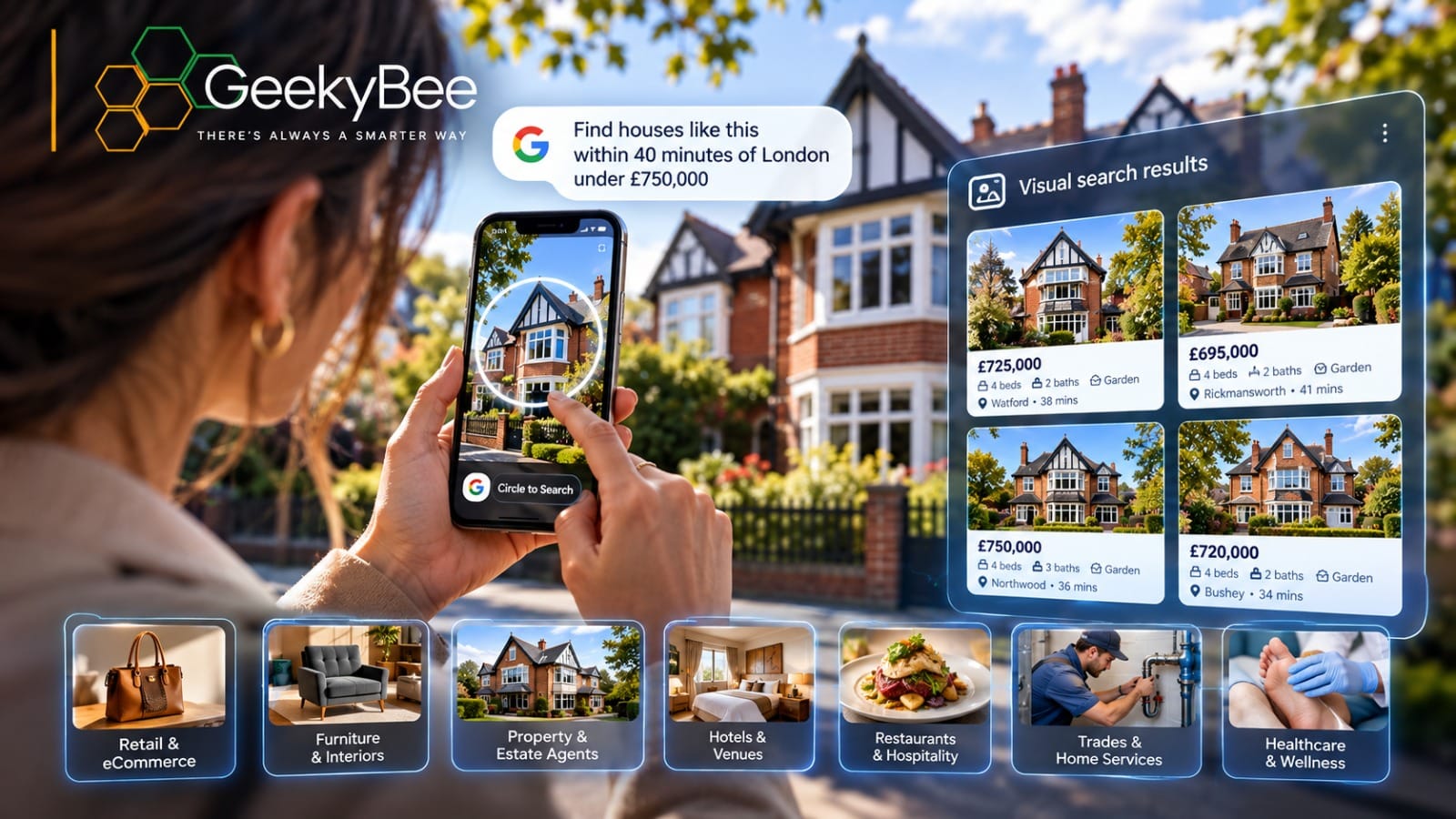
Imagine walking down a road and seeing a style of house you like.
Rather than trying to work out whether it's Georgian, Edwardian, Victorian or something built in 1997 pretending to be Victorian, you take a photograph and ask: "Find houses like this for sale within 40 minutes of London for less than £800,000."
Combine that with conversational AI and you can refine the search further: "I like that style, but I'd prefer a larger garden. I don't need to be in a premium school catchment. I'd consider somewhere requiring renovation."
That's a very different way of searching for property than: Detached → four bedrooms → £800,000 → 10-mile radius.
For estate agents, property developers, architects, interior designers and home-improvement businesses, the images on their websites are becoming part of how potential customers find them.
It's also one of the reasons GeekyBee is exploring the combination of property data and AI through technologies such as PropScope.
Property search is moving beyond simply matching homes against a set of filters.
It's increasingly about understanding what somebody actually wants - even when they can't easily describe it.
Hotels, venues and travel are natural fits for visual search
Imagine somebody sees a photograph of a wedding at a beautiful country house.
They circle it and ask: "Find me somewhere like this near London."
Or: "Where is this?"
Or even: "How much would a wedding somewhere like this cost?"
Hotels, wedding venues, restaurants, tourist attractions and event spaces are inherently visual businesses. Their websites are often packed with photographs designed to sell the experience.
Historically, those images were primarily there to persuade the person looking at the website.
Now they can help that person find the website in the first place.
That changes their role considerably.
For businesses like these, visual search isn't something to put on the “we'll worry about that in a few years” list.
It needs to start becoming part of their SEO thinking now.
Trades will be affected too
Someone photographs:
- a damaged roof tile.
- a leaking tap.
- a particular style of window.
- a cracked driveway.
- an unusual lock.
Instead of trying to describe the problem, they simply show it to Google and ask: "What is this?". "Can it be repaired?". "Who near me fixes these?"
This is where visual search, local search and AI come together. A photograph of a problem can become a search for the local business that can solve it.
That makes genuine, relevant imagery increasingly valuable.
A locksmith whose website contains real photographs of locks, installations, repairs and security products gives Google far more to understand and connect with those searches than a competitor whose website contains five generic stock photographs of somebody holding a screwdriver.
What about healthcare?
Healthcare needs a little more care, but visual search still has an obvious role to play.
Someone might photograph a skin condition, a problem with their foot, a dental issue or something else they've noticed and ask Google: “What could this be?” “Should I get this looked at?” “Who near me can help with this?”
For podiatrists, dermatologists, dentists, opticians, physiotherapists and other healthcare professionals, visual search could become another route through which potential patients find useful information and professional help.
That doesn't mean trying to diagnose someone from a photograph. It means providing accurate, responsible and well-contextualised information and imagery that Google can connect with the subject someone is researching.
The search may start with a photograph, but ultimately end with a qualified professional.
So how quickly is this going to happen?
The answer is:
Not overnight.
Google introducing multimodal reporting doesn't mean conventional search disappears in 2027, and Google hasn't told us what proportion of searches will become multimodal over the next few years.
So there's no reason to invent a crisis.
But Google has given businesses an important signal: Visual search is now significant enough to have its own reporting in Search Console.
That's worth paying attention to.
Over the next 6 - 12 months, businesses should concentrate on measurement and preparation. Find out whether you're already receiving multimodal impressions and make sure your most important visual content is high quality, properly described and easy for Google to understand.
Over the next 1 - 3 years, expect visual and multimodal discovery to become increasingly important, particularly in sectors where customers naturally search for things they can see.
Beyond that, precise predictions become speculation.
But the direction is already clear: search is becoming less dependent on the keyboard.
The good news: most businesses don't need to rebuild their websites
This isn't another mobile-first moment where businesses suddenly need completely new websites.
For most companies, the response is much simpler: Improve what you already have.
If you've got hundreds of poor product photographs, don't add hundreds more. Improve the important ones.
If you've got great photographs but very little information explaining what they show, give Google the context it needs.
If you're an estate agent, connect your property images clearly with the details of the property. If you're a hotel or venue, make sure Google can understand what your photographs actually show. If you're a restaurant, make sure the photograph of your signature dish is clearly connected to the dish itself.
The principle is straightforward:
Better images. Better context. Clearer connections between the image, what it represents, the business and the webpage.
We need to change what we measure too
Traditional SEO reporting has focused heavily on keyword rankings: “You rank fourth for this.” “You moved from position nine to position six for that.”
That's still useful. But visual search gives us something new to measure.
Instead of asking which keyword brought someone to the website, we can start asking which pages are appearing in multimodal searches, which are generating clicks, where those searches are coming from and whether that visibility is growing.
SEO reporting, therefore, needs to evolve alongside the way people search.
Rank tracking isn't becoming less useful. It's becoming less complete.
This is something GeekyBee is now watching
For GeekyBee clients, our approach is straightforward.
We're not recommending panic. We're recommending preparation.
Multimodal search is now part of how we approach technical SEO and website analysis.
Where visual discovery matters, we'll look at whether important imagery is discoverable, understandable and clearly connected to the products, properties, places or services it represents.
We'll also monitor multimodal data in Search Console, establishing a baseline now so we can see how search behaviour actually changes rather than trying to guess.
We're also looking at incorporating visual-search readiness into WebMOT, alongside technical SEO, accessibility, performance and our other website health checks.
Because we'd rather spot the change while it's happening than explain it to our customers three years after everyone else has noticed.
The internet is becoming increasingly visual
There’s a much bigger story behind Google's seemingly small Search Console update.
For decades, we've had to learn how to communicate with computers. We learned keywords, menus, filters and search boxes.
AI is reversing that relationship. The computer is learning to understand us – we can:
- speak to it.
- show it something.
- photograph something.
- circle something.
- increasingly, simply ask a question about whatever we're looking at.
That's changing search.
Not because keywords are disappearing, but because words are no longer the only language a search engine understands.
For businesses, the response doesn't need to be complicated.
Take your imagery seriously. Create original, high-quality visual content. Make sure Google understands what it represents and clearly connect it to the products, properties, places and services on your website.
Then measure what happens.
Twenty years ago, businesses learned how important it was to be visible on Google.
The next challenge is making sure Google can recognise you even when your customer doesn't type your name - or type anything at all.